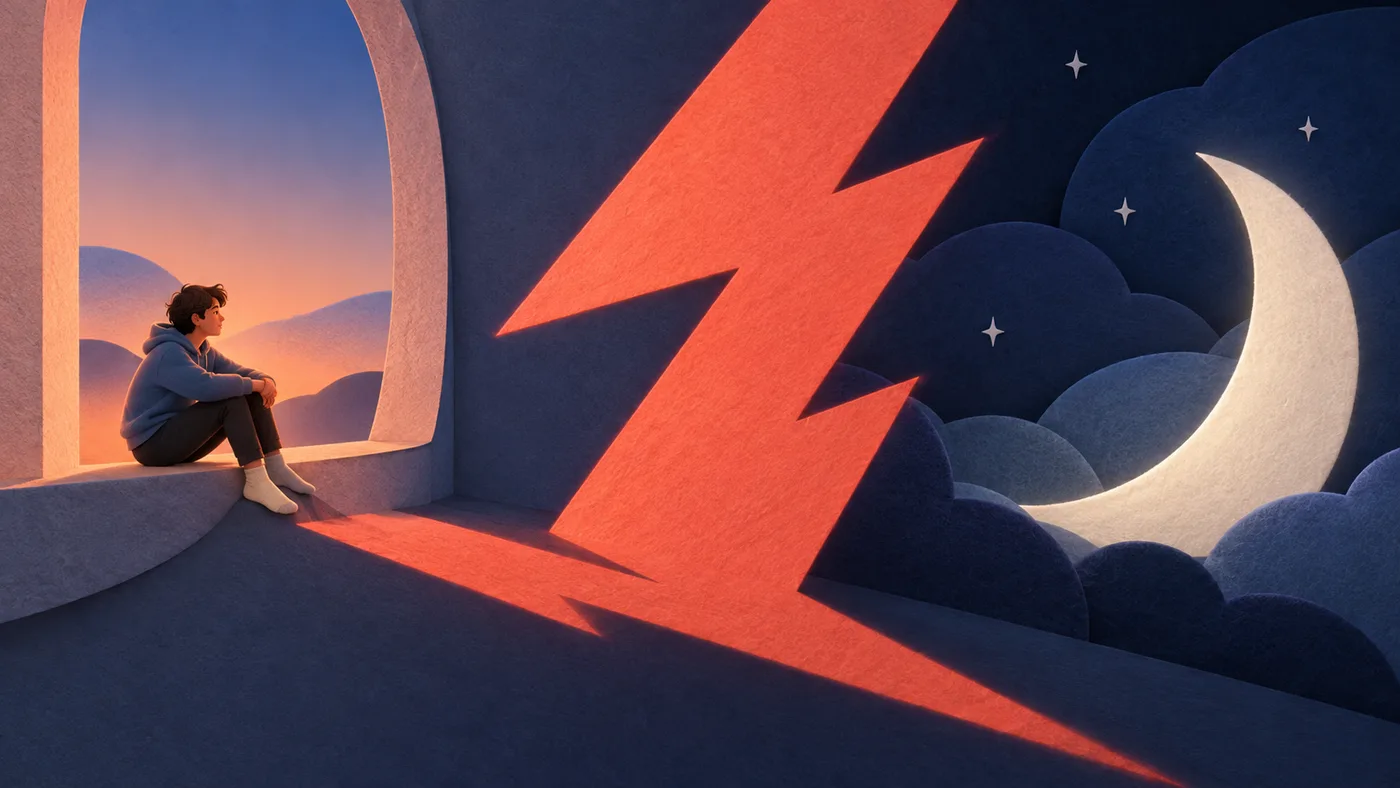
Energy drinks promise exactly what many teenagers think they need: a quick way to wake up for school, sport, gaming or an exam. Caffeine can temporarily increase alertness. That is not the same as resolving tiredness. A can may hide the cost of a short night for a few hours while the same caffeine makes it harder to sleep on time the following evening.
That is why a conversation about energy drinks is more useful than simply calling them “bad”. Parents need boundaries they can apply; teenagers deserve to understand why those boundaries exist. This article treats caffeine, sleep, sugar, sweeteners and habits as one pattern. The aim is not panic after one can. It is to prevent a temporary boost from becoming the daily answer to fatigue.
This is general information, not individual medical advice. Seek professional advice for palpitations, chest pain, fainting, severe agitation or persistent sleep problems. Contact urgent medical services for acute or serious symptoms. Do not combine energy drinks with alcohol, and take extra care when medication or a health condition can interact with caffeine.
What energy drinks do—and what they cannot do
Energy drinks contain caffeine and often sugar. Caffeine stimulates the central nervous system and can make someone feel more alert for a while. It does not create sleep, repair overload or replace a meal and hydration. The word “energy” on the package blurs two meanings: calories supplied by sugar and the wakeful sensation caused by caffeine.
According to the Dutch Nutrition Centre's guidance on energy drinks, a standard 250-millilitre can usually contains about 80 milligrams of caffeine. Larger cans and different formulations can contain more. Check both milligrams per 100 millilitres and the total volume. A large can is not necessarily one small serving.
For children and adolescents, the European Food Safety Authority uses 3 milligrams of caffeine per kilogram of body weight per day as a level that generally does not raise safety concerns. This is not a target and does not guarantee unaffected sleep or calmness. Sensitivity, body weight, timing and caffeine from cola, coffee, tea, chocolate or sport supplements all matter.
Energy drinks and sleep can create a difficult cycle
Caffeine can delay falling asleep and shorten sleep, especially when consumed later. The Nutrition Centre notes that around 1.4 milligrams per kilogram of body weight may already affect children's ability to fall asleep and their sleep duration. A teenager can therefore remain below a general safety threshold and still sleep noticeably worse.
This makes energy drinks a poor answer to fatigue. A cycle can look like this: late bedtime, tired at school, a can in the afternoon, less sleepiness in the evening, another late night, and a stronger desire for caffeine the next day. The drink does not cause every sleep deficit, but it can keep the pattern going.
Do not record only the number of cans. For one week, note when caffeine is consumed, bedtime, how long falling asleep takes and how the morning feels. The practical question is whether energy drinks help today at tonight's expense. That creates a clearer discussion than arguing about whether a drink is universally good or bad.
A fixed afternoon caffeine boundary is easier to understand than “not too much”. Because sensitivity differs, there is no perfect universal cut-off time. When sleep is already a problem, no energy drinks is the clearest experiment. Try two weeks without them and reassess morning energy, falling asleep and the weekend schedule.
Sugar matters, but it is not the whole story
Regular energy drinks often contain substantial sugar and sit outside Dutch healthy-diet guidance. Sugar supplies calories, and frequently sipping a sweet acidic drink is unfavourable for teeth. This is not, however, another general article about liquid calories. The specific issue for teenagers is the interaction between caffeine, sleep and a habit that masks tiredness.
Sugar-free energy drinks contain little or no sugar, but the caffeine does not automatically disappear. A sugar-free version may reduce sugar intake when it directly replaces the regular product. It does not remove late stimulation, restlessness or habituation. An acidic drink can also remain hard on teeth when sipped repeatedly.
Approved sweeteners have been assessed for safety within their permitted intake levels. There is no need to describe a sugar-free can as poison. At the same time, “zero sugar” does not turn a caffeinated drink into a standard thirst quencher. Water remains the simple default. Caffeine-free diet soft drinks may be a stepping stone for some families, but they need not be available all day either.
Add up every source of caffeine
A discussion focused only on energy drinks fails when coffee, iced coffee, cola and pre-workout remain invisible. Caffeine adds up. A teenager who drinks coffee in the morning, a large can after school and a stimulant supplement before training does not have three isolated habits; they have one total caffeine intake.
Read the label together. Find the can volume, caffeine per 100 millilitres and any statement that the product is not recommended for children. For sports products, check how much one scoop contains and whether the instructions suggest multiple scoops. Do not rely on phrases such as “natural energy”, “focus” or “zero sugar”. Marketing language says little about total dose.
Body weight also makes a fixed cans-per-day rule crude. The same 80 milligrams represents more caffeine per kilogram for a light thirteen-year-old than for a heavier seventeen-year-old. Some people experience tremors, headache, stomach symptoms, anxiety or palpitations at comparatively low amounts. A level that usually raises no safety concern is not an invitation to drink up to it.
School, sport and gaming need different solutions
Energy drinks may look efficient during exams, but alertness is not the same as learning. If caffeine delays sleep, the next day may begin with poorer rest. The Nutrition Centre's exam-week advice recommends regular meals and water and advises avoiding energy drinks. A planned breakfast, lunch and short movement breaks are less dramatic, but support the whole day.
An energy drink is not a sports drink. For ordinary training, water and normal meals are usually the foundation. Caffeine can affect performance in certain sporting contexts, but that does not make a brightly packaged drink necessary or appropriate for every young athlete. Discuss performance products with a sports dietitian or doctor for serious sport, especially when medication, heat or symptoms are involved.
Gaming mainly changes the timing. An evening can may make a long session feel easier and stopping feel harder. Set boundaries around both screens and caffeine. Banning only energy drinks while a teenager remains online deep into the night addresses just one link in the fatigue chain.
Practical boundaries for energy drinks at home
The Nutrition Centre's general advice is to avoid energy drinks or have them only exceptionally. Packages must state that high-caffeine drinks are not recommended for children. For older teenagers, the Nutrition Centre mentions no more than one standard can a day in a caffeine-safety context, while accounting for other sources and sensitivity. Do not turn that maximum into a daily recommendation: “no more than” and “desirable” mean different things.
Agree on rules before the pressured moment. A workable family plan might say:
1. Energy drinks are not a daily household staple or a solution to ongoing tiredness.
2. No energy drinks in the afternoon or evening when sleep is vulnerable.
3. No large cans, double servings or stacking with coffee and pre-workout.
4. Never combine them with alcohol.
5. Water is the default for thirst and ordinary exercise.
6. Symptoms mean stop and talk, not prove that you can “handle it”.
Adapt the agreement to age and context while keeping the reason consistent. Boundaries work better when parents model them. If an adult reaches for a caffeinated drink every tired afternoon, an absolute ban for a seventeen-year-old sounds less credible. Modelling does not mean adults and children need identical limits. It shows that recovery does not always come from a can.
Discuss the reason behind the habit
Ask when energy drinks become attractive. Is it taste, peer pressure, a long school day, sport, gaming, a part-time job or chronic sleep loss? Listen before prescribing an alternative. The right replacement depends on the job: cold sparkling water for thirst, food for hunger, earlier sleep for a short night, or a prepared response for social pressure.
Avoid scare campaigns and shame. An older Dutch RIVM report on energy drink use among young people found that most teenagers consumed little or none, while a small group drank heavily and had greater potential for symptoms. This supports asking targeted questions instead of treating every teenager as a problem case.
Do not design rules that reward secrecy. When a teenager hides cans after a ban, nobody knows the real caffeine intake. Clear house rules plus room to admit an exception or mistake provide better information. Correct the pattern, not the person's character.
Reducing energy drinks without drama
Daily caffeine can lead to habituation and withdrawal symptoms. Stopping abruptly may temporarily cause headache, fatigue or irritability. That does not prove energy drinks are necessary. For frequent use, gradual reduction can feel easier: remove the evening serving first, replace a large can with a smaller one, and then expand caffeine-free days.
Protect the basics while reducing intake. Provide breakfast or another suitable first meal, carry water, plan breaks and keep a steady wake time. Do not expect one healthy snack to repair months of sleep restriction. Our guide to caffeine, coffee and sleep offers wider context, although teenagers need age-appropriate individual advice rather than an adult performance plan.
If a teenager remains extremely tired despite enough opportunity to sleep, falls asleep during the day, snores heavily or has mood symptoms, speak to a doctor. Energy drinks can mask fatigue but do not automatically explain its cause. Frequent use despite symptoms, hidden cans or mixing with alcohol also deserves a calm but serious conversation.
A two-week reset for energy drinks and sleep
If arguments have replaced useful information, run a short experiment instead of making a lifelong promise. Choose fourteen days without energy drinks, keep wake time reasonably steady and record bedtime, morning tiredness and other caffeine. Do not add five new health rules at the same time. The experiment should answer one question: does removing the drink improve the sleep–fatigue cycle?
Plan alternatives around the usual trigger. Put cold water in a bag before school, eat something after class, take a short walk before homework and move gaming earlier where possible. During exam week, split revision into blocks rather than stretching it with caffeine after dinner. If sport ends late, use a normal meal and hydration instead of a stimulant routine.
After two weeks, review the results together. Better sleep or easier mornings support keeping energy drinks exceptional. No change means looking more closely at bedtime, screens, workload, mental health or a medical reason for fatigue. Either outcome is more useful than repeating a rule without learning what drives the habit.
Conclusion
Energy drinks do not repay borrowed sleep. Caffeine can temporarily increase alertness, while timing and sensitivity determine how much the night is affected. Sugar is an additional reason not to make regular versions a default drink; sugar-free lowers sugar but does not remove caffeine or habit formation.
The strongest boundary is practical: keep energy drinks exceptional, count all caffeine sources, protect afternoons and evenings, and make water the default. Then ask why the teenager wants the boost. If school pressure, gaming, sport or sleep restriction is the real issue, that issue deserves its own solution.