
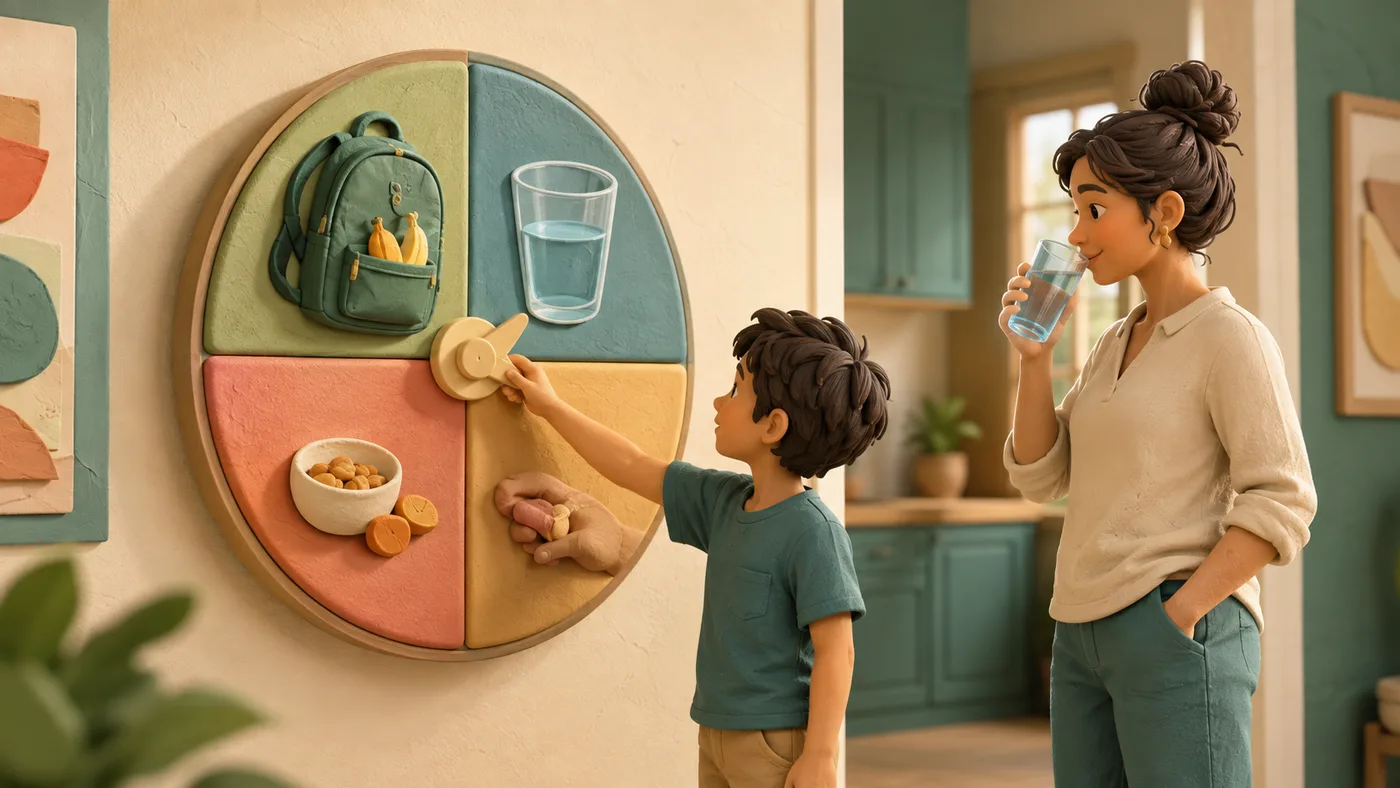
A healthy snack routine does not have to begin with a picture-perfect lunch box. It begins with predictability: when food is offered, what is usually available and how your family talks about it. When that foundation is calm and familiar, a child does not have to renegotiate every eating occasion.
Parents decide what comes into the home and when eating opportunities happen. A child gradually learns to notice hunger, appetite and fullness, and can make more choices within suitable boundaries. A healthy snack routine supports that shared job. It is not a diet for children or a system in which a biscuit is “bad” and an apple is a moral achievement.
The examples below mainly concern primary-school children. Age, growth, activity, allergies, culture and school rules all matter. If you are concerned about growth, weight, swallowing, persistently restricted eating or distress around food, consult your family doctor, youth healthcare team or a paediatric dietitian.
Why a healthy snack routine beats isolated willpower
Children do not choose in a vacuum. Food that is visible, reachable and ready to eat is easier to choose. An event that happens at roughly the same time each afternoon usually causes less debate than a rule that changes daily. The Dutch Nutrition Centre therefore recommends a regular daily pattern, keeping nutritious snacks available and making those options easy to reach.
Dutch youth healthcare guidance on eating and drinking occasions also emphasises regular times, eating together, role modelling and a pleasant atmosphere. These are environmental choices. They demand less self-control from a tired child arriving home at four o'clock.
A healthy snack routine has three simple layers:
1. a recognisable rhythm;
2. easy, suitable options;
3. language that keeps food neutral.
You do not have to change every layer today. Start with the occasion that causes the most friction, such as the school morning or the hour after coming home.
1. Give snacks a place in the daily rhythm
Grazing throughout the afternoon can reduce appetite for dinner and creates many eating and drinking occasions. For children aged four to twelve, the Dutch Nutrition Centre recommends no more than four occasions between meals; water can be offered at any time. Predictable times help a child understand that another opportunity will come.
Do not turn your healthy snack routine into a military timetable. A familiar sequence is enough: breakfast, a school snack, lunch, something after school and dinner. Timing or quantity may differ on a sports day and a quiet afternoon. A growth spurt can also increase appetite.
Explain the rhythm in advance. “After school we will have a drink and choose one snack; then we eat together tonight” gives information without a threat. If your child asks for food just before dinner, calmly refer to the next occasion. Also consider whether lunch or the afternoon snack was sufficiently filling. Structure still needs to respond to the child in front of you.
A healthy snack routine works better when caregivers apply its basic shape consistently. Agree on one simple foundation with a partner, childminder or grandparent. Every household does not need identical rules, but conflicting answers in the same afternoon understandably invite negotiation.
2. Make the everyday choice the easy choice
“There is fruit” is less helpful when it is unwashed at the back of the fridge while biscuits sit at eye level. Create one reachable place with two or three options that suit your family. These might include fruit, snack vegetables, wholegrain bread or crackers, plain yoghurt or, for older children, a small amount of unsalted nuts.
Choking precautions matter for young children. Cut small tomatoes and grapes lengthwise, and do not give whole nuts or peanuts to children under four. Adapt shape and firmness to your child's development and provide appropriate supervision.
Preparation need not become a Sunday-afternoon project. Wash a few pieces of fruit, make cups accessible and keep bread in a consistent place. The healthy snack routine needs to survive a busy Wednesday. A basket, fridge container or low shelf may be enough; the goal is accessibility, not a photogenic pantry.
Do not present occasional foods as forbidden treasure. You can buy them less often, keep them less prominent and offer a small amount at an agreed time. That changes the environment without making one food mysterious or emotionally charged.
3. Pack a school snack your child can actually eat
A school bag requires simplicity, food safety and attention to school rules. First ask when the class eats, how much time children have and what policies apply to nuts, waste or sweet drinks. A wonderful snack that is impossible to open or has become warm after several hours helps nobody.
A practical healthy snack routine formula is one familiar base item, water and, when the length of the day requires it, something extra. Examples include a banana, apple slices, snack vegetables, a wholegrain sandwich or a suitable cracker. Use an ice pack for perishable foods and choose a container your child can open independently.
Let your child choose between two suitable options: “Would you like a pear or a mandarin?” Older primary-school children can take on more responsibility by filling a bottle, choosing fruit or emptying their box after school. The parent still provides the boundary; autonomy exists in a manageable choice within it.
Check uneaten food without conducting an interrogation. The break may have been short, the portion too large, the packaging difficult, the fruit bruised or the snack simply disliked. Treat that as information for the next healthy snack routine. Do not immediately pack five alternatives in an attempt to guarantee success.
4. Make water the default drink
Drinks are part of the snack environment. Water is the simplest default and, according to the Dutch Nutrition Centre, can be offered between meals. Juice, squash, fizzy drinks and sweetened milk drinks can supply considerable sugar and increase acid exposure for teeth. A fruit drink is not equivalent to a piece of fruit.
Make water convenient: use a familiar leak-proof bottle at school, keep one cup in a regular place at home and refill at logical times. If plain water takes getting used to, offer it cool or add mint or a piece of fruit for flavour without making every drink sweet. Our practical guide to drinking water gives more ideas.
Role modelling is stronger than a lecture. When you drink water during the shared snack occasion, your child sees what “normal” looks like. A healthy snack routine feels inconsistent when adults drink fizzy drinks daily while correcting a child harshly. This does not demand perfection; you can acknowledge that adults practise choices too.
Do not treat a sweet drink as forbidden or make water a punishment. Decide when such a drink fits, offer a suitable amount and then return to the ordinary default.
5. Match the portion to the child
A child's body is not a miniature adult body that always needs precisely one quarter of an adult serving. Age, size, growth and activity differ. Begin with a modest amount and offer more if your child is still hungry, rather than serving a large adult portion that must be finished.
With packaged snacks, the packet is not automatically one child-sized portion. Some packs contain several biscuits or an amount designed for marketing convenience. Compare foods per 100 grams and check the serving actually eaten. Our guide to reading food labels explains how.
After a snack, avoid asking whether your child was “good” and finished everything. You can ask neutrally whether it was enough and what they thought of it. This keeps the healthy snack routine focused on learning to notice internal signals. A child does not have to empty a lunch box to earn approval.
If you consistently think your child eats extremely much or little, loses weight, does not grow as expected or has a sudden appetite change, do not impose substantial restriction or start calorie counting by yourself. Discuss growth and the overall pattern with a qualified professional.
6. Talk about food without shame
Words can linger. “That will make you fat”, “you have no self-control” or comments about a child's body may encourage shame and secrecy. Name foods neutrally and explain rules in practical terms: some snacks appear often because they support growth and satisfaction; other foods appear sometimes because we enjoy them.
A healthy snack routine does not have to ban sweets completely. For children aged four to twelve, the Dutch Nutrition Centre advises offering sweet snacks at planned times, keeping the amount small and maintaining a relaxed attitude. Repeatedly saying that sweets are terrible does not help. A total ban may make them more attractive.
Do not use food as comfort, punishment or reward. “If you finish your vegetables, you may have ice cream” raises the status of ice cream and turns vegetables into an obstacle. Respond to distress with attention, a cuddle or conversation. Celebrate an achievement by doing something together rather than automatically using food. Food may still be part of celebrations; affection and approval simply should not depend on eating.
Notice how you speak about your own body and diet. A parent who calls themselves “bad” after a biscuit gives an unintended lesson. Correct yourself openly: “That was an unhelpful way to say it. Food does not make anyone a good or bad person.” That models how language can change too.
7. Model the routine without performing perfection
Children observe what you do more often than they remember what you say. Sometimes eat the same fruit or sandwich, drink water, sit down for a snack and stop when you have had enough. That teaches more than a lesson about nutrients.
Role modelling does not mean adults and children always eat identical foods. Adults have different needs and may make their own choices. Explain differences calmly instead of hiding them. A healthy snack routine is about coherence: what you request should resemble what usually happens at home.
Show flexibility as well. A birthday treat, celebration or sleepover does not destroy a generally nutritious pattern. Avoid compensation, skipped meals or extra exercise to “make up for it”. Simply return to the normal routine at the next eating occasion. This teaches that health is shaped by a pattern, not one bite.
New tastes do not need to be forced. Offer them calmly more than once alongside something familiar. A child may take time to adapt and should not be mocked for dislike. Persistent distress, gagging, very few accepted foods or effects on growth and family life deserve professional assessment.
Set up a healthy snack routine in 15 minutes
Try this small family plan:
1. Choose one snack occasion that currently feels chaotic.
2. Select two or three everyday options your child can eat safely.
3. Make water accessible and prepare a school bottle.
4. Agree what the child chooses and what the adult decides.
5. Start with a suitable portion and offer more when needed.
6. Choose one neutral response for requests outside the planned time.
7. Leave relaxed room for enjoyable occasional food without compensation.
Test the setup for a week. Look beyond how much fruit or vegetables disappeared. Did arguments decrease? Did the school box fit the available break? Did your child know what to expect? Then change one element. A healthy snack routine grows through repetition, not through a complete family revolution on Monday.
If school and home differ substantially, ask about the policy with curiosity. A practical adjustment may be possible without making your child the messenger. With shared care, a short core agreement can help—for example, water as the default and one after-school snack—while details vary between homes.
Twenty questions to test your healthy snack routine
Use these questions to find one realistic improvement, not to grade your parenting:
- Does our healthy snack routine have a recognisable after-school time?
- Does my child know when the healthy snack routine offers another eating opportunity?
- Does the healthy snack routine make two everyday options easy to reach?
- Does the healthy snack routine fit the actual length of the school break?
- Can my child open the healthy snack routine container independently?
- Does perishable food in the healthy snack routine stay safely cool?
- Is water easier to reach than sweet drinks in our healthy snack routine?
- Do I usually model what the healthy snack routine asks of my child?
- Does the healthy snack routine begin with a child-sized rather than adult-sized amount?
- Can my child ask for more within the healthy snack routine when still hungry?
- Can my child stop within the healthy snack routine when comfortably full?
- Do we discuss uneaten school food within the healthy snack routine without blame?
- Does the healthy snack routine provide choice without becoming an unlimited menu?
- Does the healthy snack routine leave relaxed room for a biscuit, sweet or celebration food?
- Does our healthy snack routine avoid using food as comfort, punishment or reward?
- Do we use neutral language about bodies and weight within the healthy snack routine?
- Can the healthy snack routine adapt to sport, growth and unusual days?
- Do other caregivers know the simple foundation of our healthy snack routine?
- Do we change only one part of the healthy snack routine at a time?
- Do we know when a healthy snack routine is not enough and professional help makes sense?
If many answers are “no”, choose one. A healthy snack routine does not become stronger through twenty new rules, but through one clear change your family can genuinely repeat.
Conclusion
A healthy snack routine is built through the environment, not by repeatedly asking a child to prove that they can make the “right” choice. Use recognisable times, accessible options, water as the default, suitable portions and small choices within clear boundaries.
Stay relaxed about food that appears less often. One biscuit does not define a child's health, just as one apple cannot repair an entire pattern. Neutral language and visible role modelling make nutritious choices ordinary, predictable and achievable. If growth, restricted eating or distress causes concern, seek help early instead of making the home rules harsher.