
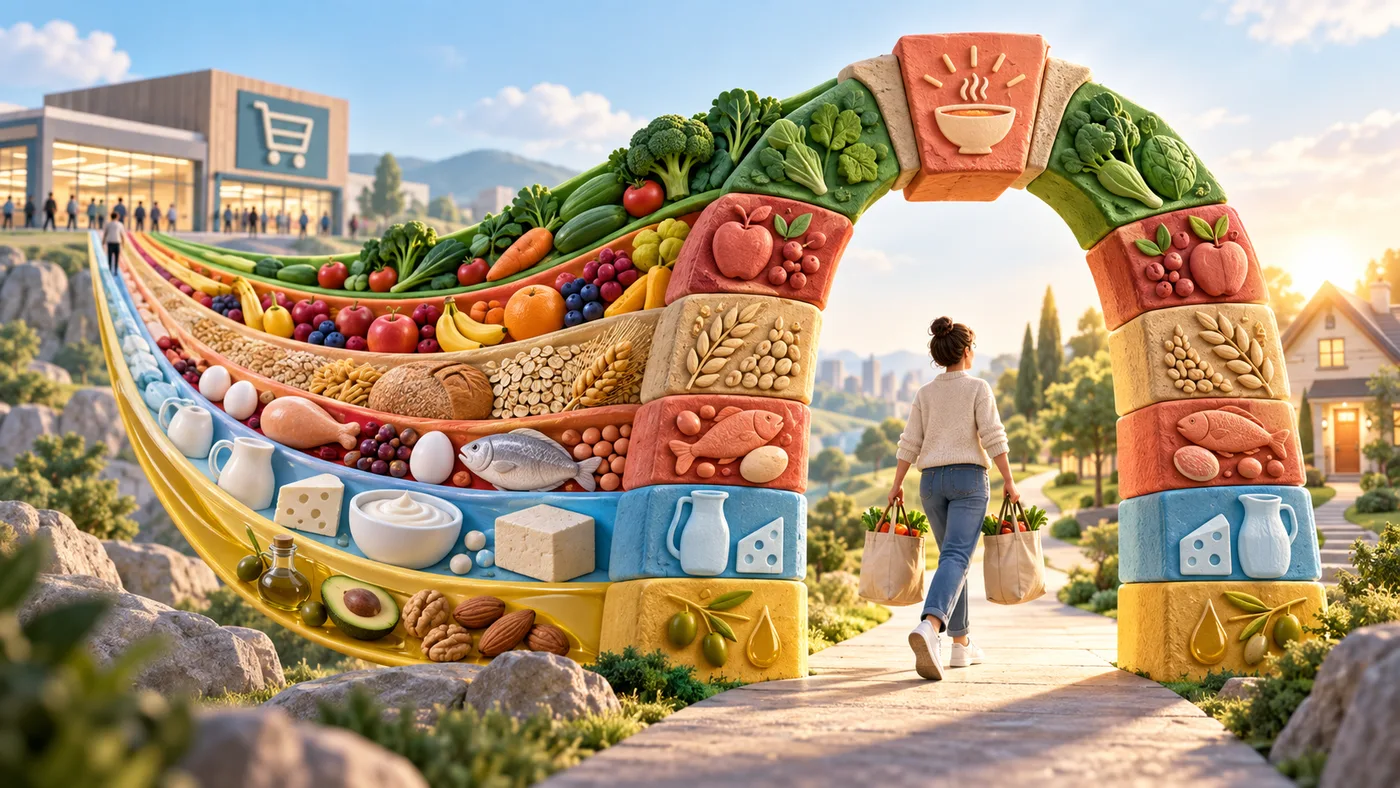
Healthy staples are not a picture-perfect cupboard filled with matching jars. They are a small, useful foundation for making breakfast, lunch and dinner on a busy Tuesday. When protein foods, vegetables, fruit, whole grains, dairy or a suitable alternative and cooking fat are available, you do not have to improvise every meal from nothing.
This is not a compulsory meal plan. Choose a few items from each group that you genuinely eat, match quantities to your household and replace only what is nearly gone. In that way, healthy staples provide structure without turning grocery shopping into a strict project.
The Wheel of Five from the Dutch Nutrition Centre provides the nutritional foundation: plenty of vegetables and fruit, whole grains, varied protein foods with an emphasis on plants, appropriately fortified dairy alternatives, and soft or liquid fats. Individual needs differ with age, activity, health, allergies and dietary preferences. Treat these examples as building blocks, not personal medical or dietary instructions.
Start healthy staples with meals, not products
A long shopping list can look complete while creating waste. Begin with five eating occasions that recur in your life. They might include oats or bread for breakfast, sandwiches for lunch, yoghurt and fruit, pasta with vegetables and beans, and rice with stir-fry vegetables plus egg or tofu.
Next, notice which building blocks appear more than once. Oats, wholegrain bread, frozen vegetables, fruit, yoghurt, eggs, pulses and oil can support many combinations. Those are your healthy staples. Spices, lemon, onions, garlic or a sensibly composed sauce can turn them into different meals.
This method is deliberately different from meal prep. You do not cook seven boxes on Sunday. You make sure that compatible components are available. You can then choose according to appetite and schedule while still preparing something straightforward.
Use these questions for a quick starting audit:
- Which three meals do we eat almost every week?
- Which fresh foods regularly spoil?
- Which basics run out first?
- When do we order food because nothing simple seems available?
- Which emergency meal would we genuinely eat at that moment?
Healthy staples should support your real household. Buying lentils because they sound virtuous is unhelpful when nobody knows how they will be used.
1. Pick two or three practical protein foods
Protein occurs in many foods. A workable collection of healthy staples does not require chicken or a protein bar at every meal. You can vary pulses, tofu or tempeh with eggs, fish, unsalted nuts, dairy and, if you choose, meat or a prepared vegetarian product.
Useful long-life options include chickpeas, lentils or beans in tins or jars without excessive salt, dried pulses when you enjoy cooking them, nuts and peanut butter made entirely from peanuts. Eggs, tofu, quark, yoghurt, fish or portions of meat may fit in the fridge or freezer. Read labels and choose products that suit your preferences, budget and storage.
The Dutch Nutrition Centre's renewed Wheel of Five encourages mainly plant-based choices and variety among pulses, tofu and tempeh, with options such as eggs, fish or meat. This is not an instruction to buy everything at once. A jar of beans, eggs and yoghurt may already provide useful variation for a small household.
Give each purchase a job: “beans for pasta or soup”, “eggs for bread or rice” and “yoghurt for breakfast”. A purpose turns a product into a practical ingredient. For more combinations, see our guide to protein snacks.
2. Combine fresh, frozen and long-life vegetables
Vegetables do not have to be exclusively fresh. The Dutch Nutrition Centre includes fresh, pre-cut, frozen, tinned and jarred choices within the Wheel of Five, depending on composition. With processed options, check added salt or sugar. Healthy staples use the different storage lives to your advantage.
You might choose two fresh vegetables for early in the week, one sturdy variety that keeps longer and two frozen options. Tomatoes and lettuce can serve quick lunches, carrots or cabbage may wait until later, and peas, spinach or a vegetable mix can stay in the freezer. Tinned vegetables or chopped tomatoes can provide additional backup.
Use fragile produce first. Put leafy vegetables or mushrooms into early meals and reserve frozen vegetables for a day when plans change. Check halfway through the week to see what needs attention. Healthy staples should reduce waste, not justify buying excessive quantities.
Wash or cut foods ahead only when it helps and does not unnecessarily reduce storage life. A whole pepper can keep better than cut pieces. Follow package storage directions and consult authoritative food-storage advice when unsure.
3. Buy fruit for your actual routine
Fruit is useful when it gets eaten in time. Combine quickly ripening fruit with longer-keeping varieties or frozen fruit. Bananas or soft summer berries may be for the first days; apples, pears or citrus often last longer. Frozen berries can go into yoghurt or oats.
Do not automatically buy seven types. Two or three varieties with clear eating occasions make better healthy staples than a full bowl discarded at the end of the week. Keep ripe fruit visible and move fruit that needs longer storage to a suitable cooler place.
Juice is not a one-for-one replacement for whole fruit. Whole fruit provides its intact structure and fibre and works as a recognisable building block. Aim for variety over time; every colour does not have to enter your trolley during one visit.
4. Keep wholegrain carbohydrates in several forms
Whole grains are not only for dinner. Wholegrain bread, oats, wholewheat pasta, brown rice, wholegrain couscous, bulgur and potatoes can support breakfast, lunch and evening meals. The Dutch Nutrition Centre recommends choosing whole grains and varying them with potatoes.
Three forms are often enough for healthy staples: one breakfast or bread option, one quick warm base and one long-life reserve. This could mean wholegrain bread in the freezer, oats in the cupboard and wholewheat pasta or brown rice for dinner.
Check labels on bread, crackers and breakfast cereals. Marketing terms such as “multigrain” do not automatically mean a product is wholegrain. Look at the legal product name and ingredient list. Our article on reading food labels explains comparisons per 100 grams and per portion actually eaten.
Freeze sliced bread in usable amounts if your household does not finish a loaf quickly. When saving cooked rice or pasta, cool and store it safely, follow storage instructions and do not depend on smell alone when food safety is uncertain.
5. Choose dairy or an appropriately fortified alternative
Milk, yoghurt, quark and cheese can be part of healthy staples. If you choose plant-based products, check fortification. For soy- and pea-based drinks or yoghurt alternatives, the Dutch Nutrition Centre specifically highlights calcium, vitamin B2 and vitamin B12. Plant drinks do not all have equivalent nutritional profiles.
Again, buy for a purpose: milk or an alternative for oats, yoghurt for breakfast or a snack, and a modest amount of cheese for bread or cooking. Avoid a large pack when half regularly spoils. The right size is financially and practically better than a theoretical saving per litre.
Allergy, intolerance, pregnancy, vegan eating or a therapeutic diet may require individual advice. Do not replace an entire food group with a random product solely because the front of its package says “plant”.
6. Keep soft and liquid fats simple
Fat is not a category to eliminate. The Dutch Nutrition Centre recommends soft and liquid fats and oils, such as soft margarine, liquid cooking fat and vegetable oils. Most kitchens do not need a row of speciality oils among their healthy staples.
Choose one oil suited to how you cook and, if useful, one soft spread for bread. Unsalted nuts or peanut butter made from one hundred per cent nuts can also have a regular place. Store oil away from light and according to its packaging, and buy a size you will use within a reasonable period.
Be aware of portions without treating fats as an enemy. Oil is energy-dense, but a suitable amount supports cooking and flavour. Measuring with a spoon can be informative if free pouring routinely becomes much more than intended.
7. Build in one real emergency meal
An emergency meal is the missing keystone in many grocery lists. After a late workday, loose ingredients requiring forty minutes of attention may not help. Healthy staples should therefore include at least one complete, extremely simple combination that you like enough to use.
Examples include wholewheat pasta with chopped tomatoes, frozen vegetables and lentils; wholegrain bread with eggs plus vegetables and fruit; frozen brown rice with stir-fry vegetables and tofu; or a vegetable-and-pulse soup with wholegrain bread. A ready-made component can also fit. Compare salt, saturated fat, fibre and actual portion size.
Here, “emergency” means a hectic evening, not a medical emergency. The combination does not have to be perfect. It needs to be faster, easier and appealing enough to beat skipping dinner or ordering solely because decision-making feels difficult.
Know which foods are reserved for this purpose and replace them after use. Otherwise the backup disappears on Wednesday and is absent on Friday. Healthy staples may include two emergency options when household members have different preferences, allergies or dietary exclusions.
A grocery formula without universal quantities
Use this simple route through your supermarket:
1. Check what needs using first at home.
2. Choose two to four vegetables with different storage lives.
3. Choose two or three fruits linked to real eating occasions.
4. Replace two or three protein foods, including at least one plant option.
5. Check bread, oats and one wholegrain warm-meal base.
6. Replace dairy or a fortified alternative if it belongs in your pattern.
7. Check oil, soft spread, nuts and flavour builders.
8. Restore the emergency meal used the previous week.
How much you buy depends on household size, portions, eating occasions and days spent at home. Healthy staples cannot be reduced to one universal quantity list. After two weeks, note what was excessive and what ran short. Remove one repeated leftover or add one reliable reserve.
Prevent a useful stock from becoming waste
Put newer products behind older ones, create a “use first” area and look in the fridge, freezer and cupboard before shopping. Keep a short list as things run out. It need not be an app; paper inside a cupboard door works.
Make one flexible leftovers meal each week. Soup, omelette, pasta sauce, curry or topped wholegrain toast can absorb several small amounts. Always respect food safety and storage times. Freezing does not stop deterioration by magic, and thawed products require correct handling.
Use special offers only when the product belongs among your healthy staples, keeps long enough and fits your storage. “Two for one” saves nothing if the second pack becomes waste.
Twenty checks for your healthy staples
- Can I make at least three ordinary dinners from my healthy staples?
- Do my healthy staples include an easy protein food?
- Do my healthy staples include a plant protein food?
- Do my healthy staples combine fresh vegetables with a longer-life option?
- Did I buy fruit for specific eating occasions?
- Do my healthy staples include a wholegrain breakfast or lunch base?
- Do my healthy staples include a wholegrain base for a warm meal?
- Does the dairy or alternative match how we really eat?
- Is a plant-based dairy alternative fortified where relevant?
- Do my healthy staples include a soft or liquid fat?
- Do my healthy staples create one complete emergency meal?
- Is that meal faster than ordering food?
- Does my household genuinely like it enough?
- Have I respected allergies and firm dietary exclusions?
- Do I know which fresh products need using first?
- Do I buy packs we actually finish?
- Is older food in front of newer food?
- Do I check cupboard, fridge and freezer before shopping?
- Do I replace reserves promptly after using them?
- Do I adjust my healthy staples through experience rather than perfection?
If many answers are “no”, choose only two improvements. You might add frozen vegetables and agree on one emergency meal. Healthy staples grow through small corrections, not through the year's most expensive trolley.
Conclusion
Healthy staples do not guarantee perfect meals. They lower the practical barrier. A few chosen protein foods, vegetables with different storage lives, fruit you genuinely eat, wholegrain bases, suitable dairy or alternatives, soft or liquid fats and one emergency meal can carry many ordinary days.
Start small, shop for your real week and review what remains. The best healthy staples are not the largest collection. They are the foods that still make an easy, nourishing combination possible when the day becomes busy.
Give your healthy staples one short weekly check. Let healthy staples support ordinary choices, keep healthy staples flexible as routines change, and avoid turning healthy staples into another standard of perfection.