
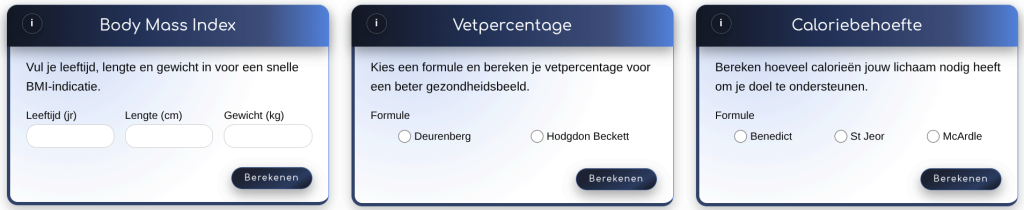
Calculator tools are not a replacement for personal coaching, but they can give you a strong first step. At FitterVitaal we use calculator tools for BMI, body fat and calorie needs to help determine a practical starting value for your Vytal nutrition settings. That fits our vision: normal healthy food, personal settings and a method you can keep using in daily life.
The value of calculator tools is clarity. Many people want to lose weight, gain weight or maintain, but they do not know which calorie target is realistic. A random app setting can be too low, too high or not personal enough. By looking at BMI, body fat and calorie needs first, you get a better starting point. After that, progress tracking and adjustment remain essential.
You can find the tools on the FitterVitaal homepage at calorie need. This article explains what each calculation does, which formula fits which type of person, how to measure properly and how to translate the result into Vytal.
Why calculator tools help your starting value
Calculator tools work best when you see them as a starting point, not as absolute truth. Your body is not a spreadsheet. Sleep, stress, training, work, hormones, water retention, digestion and measurement errors can all affect the outcome. Still, calculator tools are much better than guessing, especially when you measure calmly and consistently. The best way to use calculator tools is to measure well, start sensibly and then evaluate.
The three parts support each other. BMI gives a quick ratio between height and weight. Body fat gives more insight into what part of your weight is fat mass. The calorie calculator translates body data and activity into an estimated maintenance need. Together, these calculator tools give more context than a single scale weight.
That is exactly why BMI alone is not enough. The CDC describes BMI as a screening measure, not a diagnosis. BMI does not measure fat mass, muscle mass or fat distribution. Two people can have the same BMI while one has much more muscle and the other has more fat mass. For powerlifters, bodybuilders and other muscular athletes, BMI can therefore be misleading.
Calculator tools for BMI: quick, but limited
The BMI calculator uses the well-known formula: body weight in kilograms divided by height in meters squared. That makes BMI simple, low cost and easy to compare. For average adults, BMI can be a useful first signal. If BMI clearly rises or falls, it says something about the relationship between height and weight.
But BMI does not tell you what that weight is made of. Someone with a lot of muscle may be labelled "overweight" by BMI while body fat is healthy. Someone else may have a normal BMI but an unfavorable body composition if muscle mass is low and fat mass is relatively high. That is why BMI should always be viewed together with body fat, waist size and personal context.
Who is BMI suitable for? Mostly people with an average build who want a global indication. Who is BMI less suitable for? Powerlifters, strength athletes, very muscular people, pregnant women and anyone with an unusual body composition. In those situations, the calculator tools are more useful as a combination, with body fat and circumference measurements carrying more weight. That keeps calculator tools practical without giving BMI too much meaning.
For BMI, measure height without shoes, standing straight against a wall or using a stadiometer. Measure weight preferably in the morning, after using the bathroom and before breakfast, on the same scale. One daily value can fluctuate. A multi-day average is often more honest.
Calculator tools for body fat: clearer than BMI alone
Body fat makes the result more personal. At FitterVitaal you can estimate body fat with a BMI-based Deurenberg formula or with a circumference method. The Deurenberg formula uses BMI, age and sex. That is useful when you have few measurements, but because the formula depends on BMI, the same limitation remains: for muscular people the result may not fit well.
The circumference method uses height, neck and abdomen for men, and height, neck, waist and hip for women. This is similar to known military tape methods where body circumferences are used to estimate body fat. The U.S. Navy Body Composition Assessment also uses measurements as part of body composition assessment. The benefit of a circumference method is that it sees more than weight. The downside is that measurement error becomes large when the tape is placed incorrectly or pulled too tight.
The best practical measurement is often a professional 3- or 5-point skinfold measurement with calipers, performed by someone who knows how to do it. A skinfold measurement is not perfect, but with the same method, same points and same person measuring, it is often more useful than a quick BMI estimate. Bio-impedance scales can also help track trends, but they are sensitive to hydration, salt intake, training and timing.
How to measure better for calculator tools
Good measurement makes calculator tools much more valuable. Use a flexible tape, measure on skin or over thin clothing and do not pull the tape into the skin. Breathe out normally, relax your abdomen and measure two or three times. If the values differ a lot, measure again and use the average. When calculator tools are filled with clean measurements, the Vytal starting value becomes more useful immediately.
For the neck, measure below the larynx, horizontally around the neck. For the male abdomen measurement, usually measure at navel height, relaxed and without pulling the stomach in. For waist, measure the narrowest part of the torso or the exact point the tool asks for. For hip, measure the widest part of the hips and glutes. The most important rule is consistency: use the same point every time.
Plan measurements at comparable moments. For example, every two weeks in the morning. Do not measure directly after a heavy workout, large meal or salty evening. Do not use calculator tools to judge yourself every day. Use them to see a trend. A trend over several weeks says more than one isolated measurement.
When accuracy matters, we recommend professional help. A coach, personal trainer or lifestyle professional can perform a 3- or 5-point skinfold measurement and explain what the outcome means. That gives more context than an online calculation alone.
Calculator tools for calorie needs
The calorie calculator works with BMR and TDEE. BMR is your resting burn: the energy your body needs at rest. TDEE is your total daily energy expenditure, including activity. Our calculator tools offer multiple formulas because not every body needs the same estimate.
For most users, Mifflin-St Jeor is a strong general choice. The equation was published as a predictive equation for resting energy expenditure in healthy people, and the study is available via PubMed. Mifflin-St Jeor uses weight, height, age and sex. For average adults, that is often a sensible default.
Harris-Benedict is an older, established formula. It can be useful as a comparison, but for some people it may produce a higher result than what fits in practice. Katch-McArdle uses lean body mass. That can make it interesting for muscular athletes, but only when body fat is measured reliably. A wrong body fat percentage creates a wrong lean mass value and therefore a wrong calorie estimate.
Choose your activity level honestly. People often overestimate movement. A desk job with three workouts per week is not automatically extremely active. The calculator tools give a starting value, but your weight trend, energy, hunger and training performance decide whether you need to adjust. That is why calculator tools work best together with a short evaluation period.
From result to Vytal settings
In Vytal, you want to start with a calorie setting that is realistic. Use your TDEE as maintenance. If your goal is fat loss, about 10 percent below maintenance is often a calm starting point. With a maintenance need of 2400 kcal, that means about 2160 kcal per day. If your goal is gaining weight, about 10 percent above maintenance is practical. With 2400 kcal maintenance, that means about 2640 kcal.
That 10 percent is intentionally moderate. Many people start too aggressively. Hunger becomes stronger, energy drops and consistency gets harder. A smaller deficit often creates more calm and fits better with normal healthy food. The same applies to muscle gain: a very large surplus often mainly adds unnecessary fat. A modest surplus supports progress without pushing body weight up too fast.
The calculator tools therefore help you choose the first setting in Vytal. Then watch the trend for two to three weeks. If your weight does not decrease while fat loss is the goal, first check meals, portions and weekends. Then adjust carefully. If progress is too fast and you feel bad, the deficit may be too sharp. Used this way, calculator tools support better choices instead of becoming a strict judgement.
Practical use with Vytal and normal food
Vytal fits this approach because you work with normal meals, calories, macros and personal preferences. You do not need strange products. The starting value from the calculator tools makes the plan more personal. After that, Vytal helps you work with recipes, meal moments and settings that match your goal. That is why calculator tools fit our normal, healthy approach so well.
Use body fat mainly to choose the right formula and judge your result more honestly. If you have a reliable skinfold measurement, Katch-McArdle may be interesting. If you only have height, weight and age, simply start with Mifflin-St Jeor. If you measured circumferences carefully, use them as an extra check beside BMI.
Write down your starting values: weight, BMI, body fat, chosen formula, calorie need and target calories. That makes later evaluation easier. Without a starting point, adjustment becomes guesswork. With a clear base, you can make calmer decisions.
Medical note on calculator tools
Calculator tools provide general estimates based on averages. They are not a medical diagnosis, treatment plan or replacement for a doctor, dietitian or other healthcare professional. If you have medical complaints, use medication, are pregnant, have a history of eating disorders or are unsure about your health, get professional help before making strong calorie or nutrition changes.
For most healthy adults, calculator tools can still be a good beginning. That is true when you measure properly, stay honest about activity and use the result as a starting value. Always combine BMI with body fat and measurements. Use calorie needs as direction, not law. Then let your progress decide whether the Vytal setting is correct.


