How many calories are in a kapsalon? That is a useful question if you are trying to lose weight, track calories or simply understand your food better. A kapsalon is tasty, easy to order and for many Dutch readers a real weekend meal. It is also a high-energy meal in a relatively compact tray. That does not make it forbidden, but it does make awareness useful.
The short version: according to the Dutch Nutrition Centre, 1 kapsalon of 440 grams contains about 950 kcal, with 68.6 grams of fat, 38.7 grams of carbohydrates and 42.2 grams of protein. Real portions can be lower or higher because takeaway servings vary a lot. A small kapsalon is often around 650 to 800 kcal, a regular kapsalon around 900 to 1100 kcal and a large one can easily reach 1300 to 1500 kcal.
At FitterVitaal, we look at this without judgement. A kapsalon is not a bad food that you must never eat again. Weight loss depends on calorie balance over time. If you consistently eat less energy than you burn, you lose weight. The useful question is therefore not only how many kcal are in a kapsalon, but how you can fit a meal like this into your day, week and goal.
How many calories are in a kapsalon?
How many calories are in a kapsalon depends on the portion size, amount of fries, type of meat, cheese, sauce and salad. The strongest Dutch reference is the calorie checker from the Dutch Nutrition Centre. It lists a 440 gram kapsalon at about 950 kcal. That is a helpful anchor point, not an exact number for every takeaway shop.
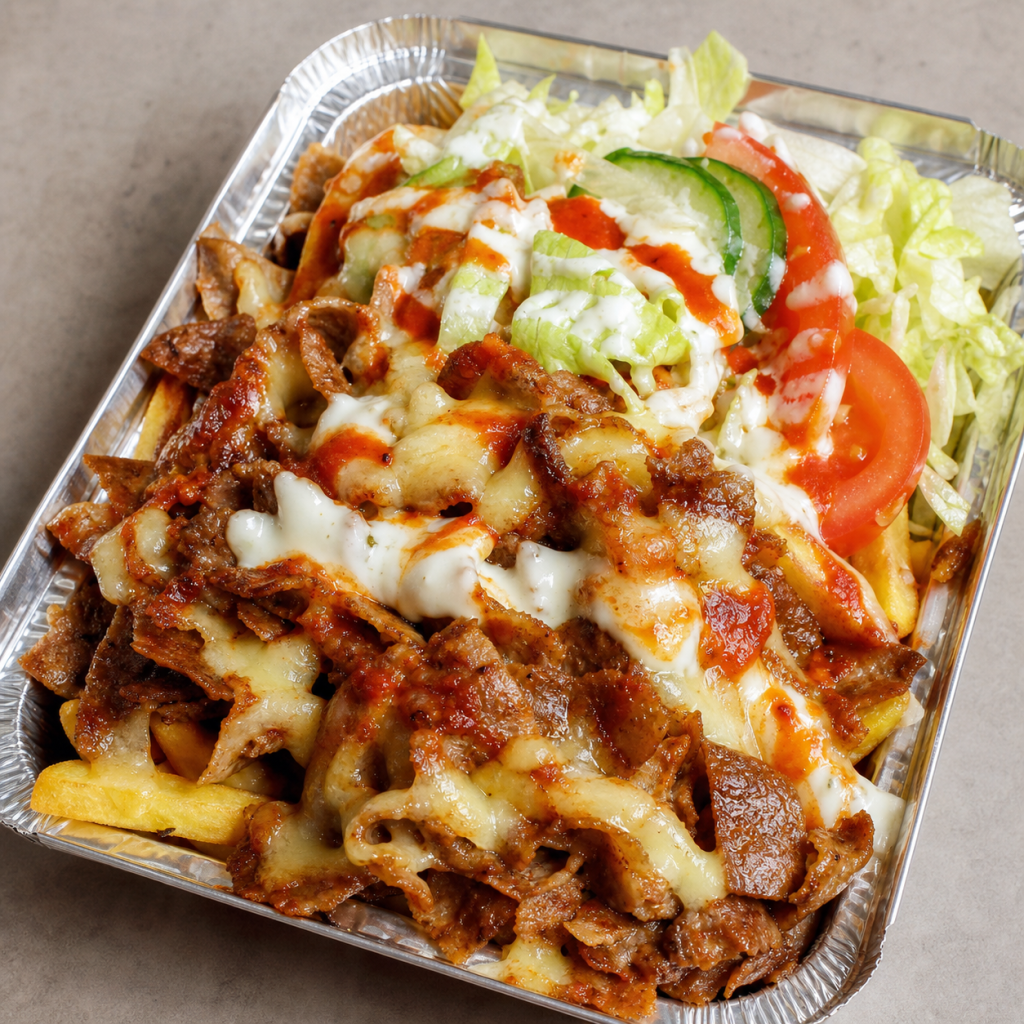
A kapsalon is usually built from fries, shawarma or doner meat, melted cheese, garlic sauce, sambal-style hot sauce and some salad. Fries, cheese, fattier meat and sauce increase the calorie total quickly. Salad adds freshness and volume, but usually does not change the overall energy value much because the tray is dominated by fries, meat, cheese and sauce.
A practical estimate:
| Portion | Weight | Kapsalon calories | Protein | Carbs | Fat |
| --- | ---: | ---: | ---: | ---: | ---: |
| Small | 300-350 g | 650-800 kcal | 28-34 g | 26-32 g | 47-55 g |
| Regular | 400-500 g | 900-1100 kcal | 38-48 g | 35-45 g | 62-78 g |
| Large | 600-700 g | 1300-1500 kcal | 58-67 g | 53-62 g | 94-109 g |
These numbers are rounded and scaled from the Nutrition Centre value of 950 kcal per 440 grams. A kapsalon with extra cheese, extra sauce or a lot of oil can be higher. A kapsalon with less sauce, leaner meat or a smaller fries base can be lower.
What is a kapsalon?
A kapsalon is a Dutch fast-food dish usually served in an aluminium tray. The base is fries. On top come shawarma, doner, chicken doner or another seasoned meat. Cheese is added and the tray is often grilled briefly so the cheese melts. Garlic sauce, hot sauce and salad are added afterwards.
The dish became famous in Rotterdam. It combines many flavours: salty, fatty, creamy, spicy, fresh and crunchy. That makes it a comfort meal for many people. The same combination also makes it calorie dense. Fries provide carbohydrates and fat, meat provides protein and fat, cheese provides fat and protein, and sauce mostly adds fat and sometimes sugar.
That does not mean a kapsalon is useless. It can contain a solid amount of protein. A regular portion may provide around 40 grams of protein. The issue is that this protein comes together with a lot of fat, salt and total energy. If you track calories, you need to look at the whole meal.
Kapsalon nutrition and macros
Kapsalon nutrition is mainly about three macros: protein, carbohydrates and fat. Protein comes mostly from the meat and cheese. Carbohydrates come mostly from the fries and sometimes sauce. Fat comes from frying oil, meat, cheese and sauce. That is why the total rises quickly.
According to the Dutch Nutrition Centre, 440 grams of kapsalon contains about:
- 950 kcal;
- 68.6 grams of fat;
- 14.5 grams of saturated fat;
- 38.7 grams of carbohydrates;
- 8.4 grams of sugars;
- 5.3 grams of fibre;
- 42.2 grams of protein;
- 3.7 grams of salt.
For calorie tracking, the fat content is important to understand. Fat provides 9 kcal per gram. Carbohydrates and protein provide about 4 kcal per gram. A high-fat meal can therefore become high in calories even when the tray does not look enormous.
The protein is a positive point, especially when you are losing weight and want to maintain muscle. Still, a kapsalon is usually not the most efficient high-protein daily meal, because the ratio between protein and total calories is not very favourable. You get plenty of protein, but also a lot of fat and salt.
Can a kapsalon fit into a weight-loss diet?
Yes, weight loss and kapsalon can go together. The condition is that your total calorie intake over the day or week still fits your goal. If your maintenance intake is 2400 kcal and you are losing weight on 2100 kcal, a regular kapsalon of 950 kcal takes almost half your daily budget. That can work, but it requires planning.
The problem is not that kapsalon is forbidden. The issue is that it leaves less room for other meals when you want to stay in a calorie deficit. If you already had a normal breakfast, lunch and snacks, a large kapsalon can easily push your daily total above maintenance.
Planning ahead works better. If you know you want kapsalon in the evening, keep breakfast and lunch simple, high in protein and filling. Think of low-fat yoghurt with fruit, an omelette with vegetables, wholegrain bread with lean toppings or a large salad with chicken or tuna. Not as punishment, but as balance.
Use the FitterVitaal calorie need tool to estimate maintenance and target calories. For more context on BMI, body fat and calorie needs, read our calculator tools for BMI, body fat and calories.
How much exercise is needed to burn off a kapsalon?
It is tempting to translate food directly into exercise. That can create perspective, but it should not become a punishment system. Exercise is useful for health, fitness, muscle retention and energy expenditure. You do not need to "earn" or "undo" a kapsalon. Still, it helps to know what 950 kcal roughly means.
For a person of about 73 kg, Mayo Clinic lists approximately 314 kcal per hour for walking at 3.5 mph, 606 kcal per hour for running at 5 mph, 292 kcal per hour for leisurely cycling and 423 kcal per hour for light to moderate lap swimming.
For a regular 950 kcal kapsalon, that is roughly:
- walking: about 3 hours;
- leisurely cycling: about 3 hours and 15 minutes;
- swimming: about 2 hours and 15 minutes;
- running: about 1 hour and 35 minutes.
These are estimates. Your real burn depends on body weight, speed, fitness, terrain and intensity. A heavier person usually burns more per hour. A lighter person usually burns less. Treat movement as helpful context, not exact bookkeeping.
Tips to enjoy kapsalon while maintaining a calorie deficit
If you want to lose weight and still eat kapsalon sometimes, you do not need a strict ban. You need a plan. These tips make kapsalon calories easier to fit without derailing the week.
- Choose a small kapsalon instead of a large one. That can save hundreds of kcal.
- Ask for sauce on the side so you control the amount.
- Choose chicken doner or chicken shawarma if your shop offers a leaner version.
- Skip extra cheese or ask for less cheese.
- Share a large kapsalon and add a salad.
- Eat slowly and stop when you have had enough, even if the tray is not empty.
- Make the rest of the day higher in protein and fibre.
- Expect salt and water weight: the scale may be temporarily higher the next day.
- Track realistically. When in doubt, estimate slightly higher.
- Make a lighter home version with oven fries, chicken breast, plenty of salad and yoghurt sauce.
A practical mindset is to treat kapsalon as a weekly choice. Not because it is bad, but because it is calorie dense. If most of your week is consistent, a kapsalon can fit without ruining your progress.
Tracking kapsalon in Vytal
In an app or nutrition plan, you can track kapsalon in two ways. The easiest method is using an existing entry, for example around 950 kcal for a regular portion. That is quick and often good enough if you eat kapsalon occasionally.
The more accurate method is entering the ingredients separately: fries, meat, cheese, sauce and salad. That takes more work but gives better insight. Sauce and cheese especially can make a big difference. If you eat kapsalon often or want tighter calorie control, separate tracking can be useful.
With the Vytal app through FitterVitaal, the goal is not perfect eating. The goal is overview. You can see what a meal does to your daily calories and macros. Then you can choose consciously: today a regular kapsalon fits, or today a smaller portion leaves more room for another meal.
Example: fitting kapsalon into a day
Imagine your target is 2100 kcal per day. You want a regular kapsalon of about 950 kcal in the evening. That leaves about 1150 kcal for the rest of the day. That is not a huge amount, but it can work.
Example day:
- Breakfast: low-fat yoghurt, fruit and some oats, about 350 kcal.
- Lunch: large salad with chicken, wholegrain crackers and light dressing, about 450 kcal.
- Snack: fruit or a protein-rich snack, about 150 kcal.
- Dinner: regular kapsalon, about 950 kcal.
- Total: about 1900 kcal.
This is only an example. The point is that you create space without starving yourself. Protein, vegetables, fruit and fibre help keep the day filling. If that type of day makes you too hungry, choose a small kapsalon or share a portion instead.
Common mistakes with kapsalon calories
The first mistake is tracking a large kapsalon as a regular portion. Many takeaway trays are bigger than people think. If in doubt, choose the higher estimate. That gives more honest data.
The second mistake is forgetting sauce. Garlic sauce looks like a detail, but a generous amount can add many calories. Asking for sauce on the side is a simple way to keep control without removing the flavour.
The third mistake is extreme compensation. If you eat almost nothing the day after a kapsalon, food becomes mentally heavier than needed. Look at your weekly average instead. A high-calorie meal fits better when the rest of the week is calm and consistent.
The fourth mistake is assuming exercise solves everything. Exercise helps, but burning 950 kcal takes time. It is usually easier to manage portion size, sauce and day planning than to burn everything afterwards.
FAQ about kapsalon calories
How many kcal are in a kapsalon on average?
A regular kapsalon of about 440 grams contains around 950 kcal according to the Dutch Nutrition Centre. Small portions are often around 650 to 800 kcal. Large portions can reach 1300 to 1500 kcal.
Is kapsalon bad for weight loss?
No, not automatically. Weight loss depends on total calorie balance. A kapsalon is calorie dense, so it takes a lot of space in your daily budget. But with planning, it can fit into a calorie deficit.
What macros are in a kapsalon?
A regular portion contains roughly 42 grams of protein, 39 grams of carbohydrates and 69 grams of fat. Exact macros vary by takeaway shop and ingredients.
How many calories are in a small kapsalon?
A small kapsalon is often around 650 to 800 kcal. The exact number depends on weight, fries, meat, cheese and sauce.
How many calories are in a large kapsalon?
A large kapsalon can easily contain 1300 to 1500 kcal. Extra cheese, extra sauce and a larger fries base push the number up quickly.
Can I eat kapsalon and still lose weight?
Yes. Plan the meal, choose a smaller portion if needed, ask for sauce on the side and make sure your weekly average still creates a calorie deficit.
Is homemade kapsalon healthier?
A homemade kapsalon can be lower in calories if you use oven fries, lean meat, less cheese, more salad and a lighter sauce. The main advantage is portion control.
Do I need to compensate for kapsalon with exercise?
No. Exercise is healthy, but it should not be punishment. It is more practical to plan your calories across the day or week and use movement as support.
Conclusion
How many calories are in a kapsalon? For a regular portion, about 950 kcal is a realistic reference, with a lot of fat, a decent amount of protein and plenty of salt. Small portions are lower, while large portions can go well above 1300 kcal.
A kapsalon does not have to disappear from your life when you want to lose weight. It simply asks for awareness. Think in terms of portion size, sauce, day planning and weekly averages. Use tools such as the FitterVitaal calorie calculator, BMI calculator and Vytal to create overview. Then a kapsalon becomes a conscious choice inside a sustainable plan, not a forbidden meal.


