
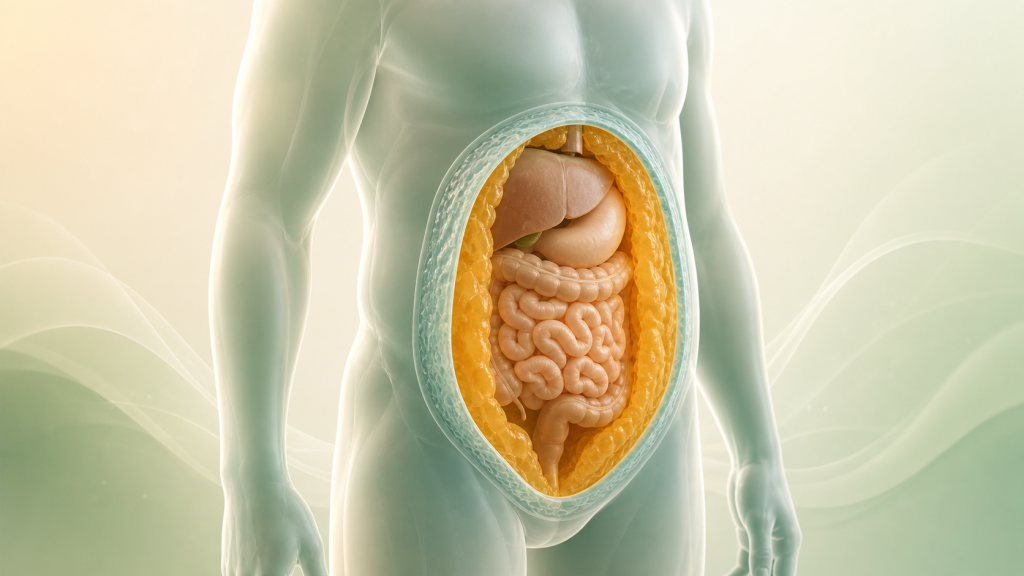
**Belly fat** is often discussed as an appearance problem, but that is not the most useful way to understand it. Where fat tissue is stored matters for health. Fat immediately beneath the skin differs from fat deeper inside the abdominal cavity around the organs. Two people with the same weight or BMI can therefore have different health-risk profiles.
A scale reports total mass. It cannot tell you how much is muscle, fluid, bone or fat, and it cannot show where fat is stored. Waist circumference adds useful information. It is not a grade for your body and it does not diagnose disease. It is one practical risk marker alongside blood pressure, blood glucose, cholesterol, fitness, family history and other factors.
This article offers general information for adults. Pregnancy, certain health conditions, major weight changes and distress around body measurement all require more individual context. Discuss concerns or results with your doctor or dietitian rather than trying to infer a disease from one number.
What kind of belly fat are we discussing?
Subcutaneous fat lies directly under the skin. You can often pinch it, and it contributes to insulation and protection. Visceral fat sits deeper in the abdominal cavity, between and around organs. Everyone has both types. Some fat tissue is normal and functional; the health concern is excess deep fat in combination with a person's broader risk factors.
The Dutch Heart Foundation's waist guidance explains that visceral fat surrounds important organs and that excess amounts can be harmful. This tissue is biologically active. It can release substances associated with inflammatory processes and changes in how the body responds to insulin. That helps explain why excess **belly fat** is more closely associated with type 2 diabetes and cardiovascular disease than fat around the hips and thighs.
A soft abdomen does not automatically mean poor health, and visible fat cannot reveal the exact amount of visceral fat. Medical imaging can show distribution more precisely, but it is usually unnecessary for routine risk assessment. Waist circumference is used as a simple estimate at population level.
Why belly fat differs from body weight
BMI divides weight by height squared. It is useful for describing broad weight categories and populations, but it cannot see fat distribution. A muscular person may have a high BMI with relatively little fat. Someone whose BMI falls within a commonly used healthy range may still carry relatively more fat around the abdomen.
The Dutch Diabetes Fund on BMI and waist size consequently stresses that BMI is not the only relevant measure. Waist circumference accounts for some of the additional risk linked with abdominal fat. Think of the two measurements as separate lenses: height and weight provide a broad ratio, while the waist gives a clue about distribution.
Scale weight and waist size do not always move together. Fluid, salt, carbohydrate stores, gut contents and hormonal changes can move weight over short periods. Waist measurements also contain noise, but usually do not change because of one salty meal. Look for a trend over weeks rather than daily millimetres.
You can read more about short-term variation in why daily weight fluctuates. That context helps you avoid treating a temporarily higher scale reading as failure when the waist trend is stable, or assuming every quick loss represents less deep abdominal fat.
How to estimate belly fat with waist circumference
Use a flexible tape. Measure against bare skin while standing upright, after a relaxed breath out. Place the tape horizontally midway between the lowest rib and the top of the pelvis; for many people this is just above the navel. Let it sit snugly without compressing the skin. This follows the method described by the Heart Foundation.
Keep conditions comparable if you track change: for example, measure in the morning before breakfast once every two to four weeks. Take two readings. If they differ noticeably, take a third and use the middle result. Measuring every day mainly produces noise and unnecessary attention.
For many adults of European, Middle Eastern, Mediterranean or American background, the Heart Foundation lists these ranges:
- for men: lower risk below 94 cm, increased risk from 94 to 102 cm and substantially increased risk from 102 cm;
- for women: lower risk below 80 cm, increased risk from 80 to 88 cm and substantially increased risk from 88 cm.
These thresholds are not universal biological laws. Different cut-offs apply to some ethnic groups because body composition and metabolic risk relate differently. Age and individual health also matter. The Diabetes Fund notes, for example, that the usual boundaries may be too low for people over 70. Use a chart to start a contextual conversation, not to diagnose yourself.
What a larger waist does and does not prove
A larger circumference increases the average likelihood of carrying more visceral **belly fat**. That is why the Diabetes Fund's type 2 diabetes risk explanation includes waist size. Genetics, age, activity, food patterns, smoking, blood pressure and a history of gestational diabetes also influence risk.
A measurement above a threshold does not prove that you have diabetes, fatty liver disease or cardiovascular disease. A result below it does not guarantee that every marker is healthy. Someone can have a smaller waist and high blood pressure or adverse cholesterol. Another person with a larger waist may currently have blood results within reference ranges.
The useful approach is to combine signals. If waist circumference is rising and you also have a family history of type 2 diabetes, elevated blood pressure, low activity or abnormal blood results, a conversation with your clinician is particularly worthwhile. They can decide whether blood pressure checks or laboratory tests are appropriate.
Shame adds no medical information. **Belly fat** reflects an interaction between energy intake, activity, sleep, stress, hormones, age, genetics, medicines and environment. Where a person stores fat says nothing about their effort, character or worth.
Can you burn only belly fat?
Abdominal exercises strengthen the trunk muscles but do not choose where the body releases stored fat. Spot reduction through crunches, wraps, creams or sweat belts is not a realistic mechanism. When a suitable energy deficit reduces total fat mass, genetics and hormones help determine where changes appear first.
That can feel frustrating when the abdomen changes slowly. It is still not a reason for an extreme plan. An approach that protects muscle, energy and adherence matters more than a rapid drop that consists largely of fluid or lean tissue. Strength training while losing weight can support muscle and function alongside ordinary daily movement.
Lifestyle research also looks beyond kilograms. In its 2024 report on combined lifestyle interventions, the Dutch National Institute for Public Health and the Environment reports that programmes monitor waist circumference and quality of life alongside weight. That reflects a broader understanding of progress.
Lifestyle foundations that can reduce visceral belly fat
No particular food selectively melts deep **belly fat**. The foundations are less dramatic and better supported: a workable eating pattern, enough movement, sleep and attention to stress. For people with excess weight, gradual loss of total fat mass can also reduce visceral fat.
Build meals that satisfy
Base most meals around vegetables and fruit, whole grains, pulses, appropriate protein sources and unsaturated fats. Protein and fibre can make meals more filling. Liquid calories, alcohol and energy-dense snacks are easy to add without producing the same fullness as a balanced meal. Nothing has to be permanently banned; identify repeated choices that have the largest practical effect.
A modest energy deficit is often more sustainable than a crash diet. Severe restriction can contribute to fatigue, muscle loss and rebound eating. If you take medication, have diabetes or live with another medical condition, seek professional support to tailor the plan.
Combine everyday movement with training
Walking, cycling, taking stairs and breaking up long sitting periods all accumulate. Add muscle-strengthening activity where possible and increase aerobic training gradually. The best activity is not the one with the boldest promise about **belly fat**. It is the combination you can perform safely and consistently.
Start small if you currently move little: walk for ten minutes after a meal, complete two brief strength sessions per week or stand up each hour. Increase duration or intensity step by step. Chest pain, unexplained breathlessness, dizziness or known heart disease calls for medical advice before vigorous training.
Treat sleep and stress as real parts of the plan
Insufficient sleep can affect appetite, recovery and daily decisions. Persistent stress can disrupt movement, alcohol intake, eating occasions and sleep as well. This does not make stress a simple direct explanation for every centimetre of **belly fat**. It means that a plan without recovery is often harder to carry out.
Try a consistent waking time, limit caffeine late in the day and create a short transition between work and evening. Do not turn an elaborate perfect morning routine into another burden. Find one small action that makes the next choice easier.
Track progress without becoming consumed by it
If measurement is useful to you, select only a few indicators: waist circumference every two to four weeks, weight as a weekly average, the number of walks or workouts, and perhaps blood pressure when professionally advised. Record conditions that could affect comparisons.
Notice functional signals too. Are stairs easier? Do you recover better? Can you lift more with control? Is sleep more regular? Does clothing fit differently? Metabolic health is bigger than one circumference, and **belly fat** is bigger than a cosmetic goal.
Stop measuring at home if it leads to repeated checking, skipped meals, panic or harsh self-criticism. You can improve your habits without using a tape. A clinician or dietitian can assess risk in a wider conversation.
Use the trend mainly to ask better questions. **Belly fat** cannot be judged from one measuring day. **Belly fat** means too little without age, background and blood markers. **Belly fat** may decrease while daily weight fluctuates. **Belly fat** does not respond to one perfect meal or workout. **Belly fat** therefore calls for the same calm repetition as other health goals.
Keep the review practical. Assess **belly fat** over months rather than days. Do not connect **belly fat** with punishment or shame. Discuss **belly fat** with a professional when several risk factors coincide. Treat less **belly fat** as one possible result of a healthier pattern, not the only reason to move. Remember that **belly fat** is only one part of metabolic health.
When to seek professional help
Book an appointment if your waist is clearly increasing without an obvious explanation, if several risk factors apply, or if you want to know whether blood pressure, glucose or cholesterol should be checked. Seek help sooner for severe or persistent abdominal pain, a rapidly distended abdomen, breathlessness, fluid retention, unexplained weight loss or other new symptoms. Not every larger abdomen is **belly fat**.
Ask for support as well if weight-loss attempts repeatedly lead to severe restriction and binges, or body measurements dominate your daily life. Good care should address health and your relationship with food and your body.
The balanced conclusion
The scale is not useless, but it tells an incomplete story. Waist circumference adds information about where fat is probably stored. Excess visceral **belly fat** is associated with a higher average risk of type 2 diabetes and cardiovascular disease.
Use that knowledge without reducing your body to a number. Measure carefully and infrequently, interpret thresholds in the right context and combine the result with other risk factors. Then work on ordinary behaviours you can repeat for months: filling meals, daily movement, strength training, sleep and recovery.
You do not have to hate **belly fat** to take your health seriously. A changing waist is information, not a verdict. The best next step is not the harshest intervention, but the smallest approach that is safe, suitable and sustainable.
Treat **belly fat** as a risk signal, track **belly fat** only when that feels useful and always place **belly fat** in the wider health picture. Let **belly fat** inform a conversation rather than dictate your self-worth.
In short, **belly fat** is useful context, never a personal verdict.


