
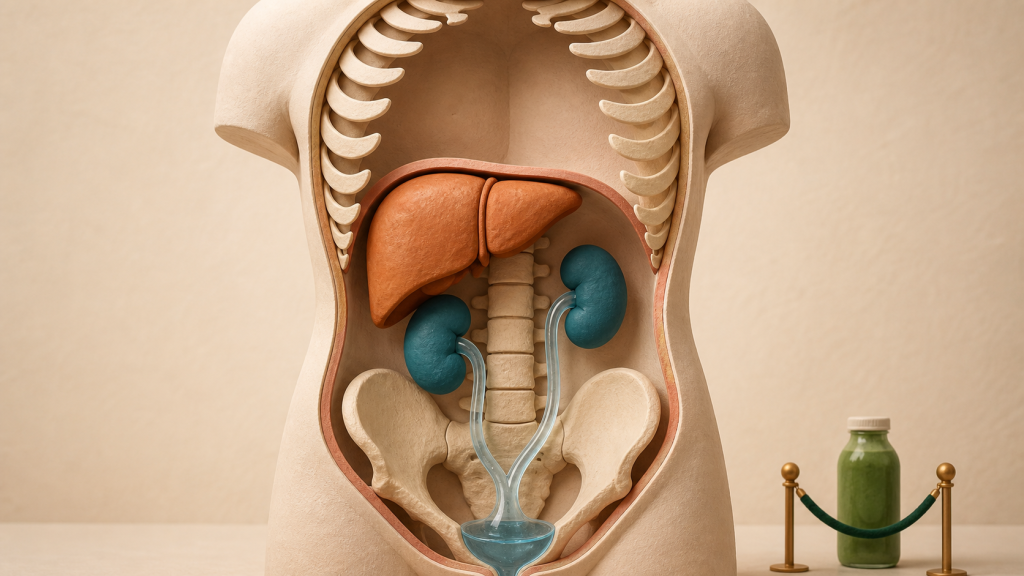
A **detox** promises exactly what can sound appealing after a spell of large meals, alcohol, poor sleep or irregular days: a clean slate in three, five or seven days. You drink juice, tea or water, remove normal meals and supposedly flush “toxins” from your body. The number on the scale may fall as well, which can look like proof that the cleanse worked.
Lower weight does not prove that toxins disappeared. Your body does not need a seasonal deep clean before its normal processing begins. Your liver, kidneys, gut and lungs are continuously involved. A **detox** may sharply reduce energy intake, change water and glycogen stores and restrict your diet for a few days. That is different from medically demonstrated detoxification.
This article provides general information, not personal medical advice. If you have diabetes, kidney or liver disease, take medication, are pregnant or are breastfeeding, discuss a restrictive cleanse with your doctor or dietitian first. A genuine poisoning requires urgent medical care; a commercial **detox** is not a treatment for it.
What does detox actually mean?
The word is used loosely. One seller means vegetable and fruit juice, while another sells fasting, supplements, activated charcoal, clay, laxatives, colon cleansing or some combination of them. Unless a claim identifies the substance being removed, explains how it is measured and shows a plausible mechanism, “cleansing” is not a testable health outcome.
The Dutch Nutrition Centre's overview of detoxification and cleansing concludes that these methods do not have adequate scientific evidence behind them. The body has its own waste-processing systems, mainly involving the liver while the kidneys and gastrointestinal tract also contribute. A retail **detox** has not been shown to accelerate those normal systems.
Medical detoxification does exist. It may involve treating a known poisoning or providing supervised withdrawal care for substance dependence. It has a defined clinical reason and professional oversight. That meaning should not be confused with a box of juices promoted on social media.
Detox does not give your liver and kidneys a day off
Your liver performs hundreds of tasks. It processes nutrients, makes bile and proteins, breaks down certain compounds and transforms others so they can be excreted. It is not a drain in which dirt sits until lemon water pulls out the plug. It is an active organ performing chemical conversions around the clock.
Your kidneys filter blood and regulate water, salts and acid-base balance. The Dutch Kidney Foundation explains that kidney filters remove waste, excess water and salts into urine while retaining useful substances such as proteins in the blood. More water is therefore not automatically better: healthy kidneys manage a balance, not a litres-drunk competition.
The exact route differs by substance. Some compounds are transformed by the liver; others leave through urine, faeces or exhaled air. Dose, exposure, health and time matter too. A claim that one **detox** removes “all toxins” hides this complex reality instead of explaining it.
Why a juice cleanse can still make you lighter
A juice cleanse can quickly lower scale weight. It usually supplies less energy and often less carbohydrate and salt than your normal diet. As glycogen stores change, their associated water changes too. There is also less food moving through your digestive system. These shifts are real, but they are not evidence that mysterious toxins have been removed.
The Dutch Nutrition Centre's guidance on smoothies, pills and weight-loss products says that juice-cleanse weight loss occurs because energy intake is lower. When normal eating resumes, water, glycogen and gut contents may rise again. That is not a failed **detox**. It is a predictable physical response.
A bottle of vegetable or fruit juice is not automatically unhealthy. The problem appears when juice replaces a complete varied diet and is paired with sweeping cleansing claims. Juice usually contains less fibre than whole fruit and vegetables. Juice alone may also provide insufficient protein, essential fats and other nutrients. Very low energy intake can cause fatigue, dizziness, headaches and difficulty concentrating.
Someone may genuinely feel less bloated after three days. Possible explanations include less alcohol, fewer large meals, less salt, more regular timing or simple expectation. The experience matters, but it does not identify which “toxin” the **detox** supposedly removed.
The risks often hide in the extras
Not every short cleanse makes a healthy adult immediately ill. Still, “natural” does not mean risk-free. Problems with a **detox** may come from combining severe restriction, excessive fluids, herbs, supplements or laxative products. Dose and personal circumstances matter.
The US National Center for Complementary and Integrative Health warns about dehydration from diarrhoea, dangerous electrolyte imbalances from consuming very large amounts of water or herbal tea without food, illness from unpasteurised juice and high-oxalate juices for people susceptible to kidney stones. It also notes that severely restrictive diets may not provide all the nutrients a person needs.
Supplements do not automatically make a **detox** gentler. Herbal extracts can cause adverse effects or interact with medicines. Multi-ingredient products make it difficult to know which ingredient caused a reaction. Activated charcoal can bind medicines and nutrients; it is not a routine wellness product. The Dutch Nutrition Centre advises against cleansing clay because such products may themselves contain harmful substances.
Laxatives empty the bowel but do not remove body fat or switch on the liver. Diarrhoea mainly loses water and salts. Colon irrigation is not necessary maintenance for a healthy bowel and can cause complications. Feeling ill, weak or dehydrated does not show that a **detox** is powerfully working.
Five questions that expose a detox claim
Marketing becomes easier to judge when you make its language concrete. Ask these questions before paying:
1. **Which substance is being removed?** “Waste” with no name or measuring method is too vague.
2. **How do they know it is present before the programme?** A fatigue questionnaire does not prove accumulation.
3. **How is the result measured?** Weight loss, more bowel movements or darker urine do not measure detoxification.
4. **Is there independent research on this exact product?** A study of one ingredient does not prove that the package works.
5. **Which risks, interactions and exclusions are disclosed?** Testimonials without safety information are a warning sign.
Be cautious with phrases such as “reset your metabolism”, “flush away fat” and “remove years of build-up”. Ask what they mean operationally. If the answer repeatedly uses headaches, skin, tiredness or bowel movements as proof, the **detox** remains impossible to verify.
What supports your body instead?
You do not need a special ingredient to make your organs work. You can create conditions that make healthy behaviours easier to sustain. That sounds less dramatic than a colour-coded package with a countdown, but it remains useful after the programme ends.
- Eat a varied diet with vegetables, fruit, whole grains, pulses and appropriate protein sources.
- Drink according to your needs, circumstances and any personal medical advice. Read how drinking enough water differs from drinking as much as possible.
- Limit alcohol or choose alcohol-free days; juice cannot undo earlier alcohol intake.
- Move regularly and make room for rest and sleep.
- Take medicines as prescribed and discuss supplements if you have a condition or use other products.
- If weight loss is your goal, build a modest sustainable energy deficit instead of a short crash.
These steps do not “wash” your liver. They are ordinary behaviours that support general health. If you enjoy a firm start date, keep that feature without the **detox** story: try seven days of normal meals, no alcohol, consistent bedtimes and a daily walk. You will then practise actions that remain usable on day eight.
Turn the desire for a reset into something useful
The appeal of a **detox** is not foolish. A defined programme reduces decision fatigue, creates a starting point and can feel restorative after a chaotic period. Keep those strengths, but remove the unsupported cleansing claim.
Choose one reason you want a reset. Do you want to wake less bloated, eat breakfast regularly, avoid weekday alcohol or stop mindless snacking? Then define one observable action. “I will eat lunch every working day this week” is more useful than “I will remove toxins”.
Plan the ending too. Many commercial programmes explain exactly what to drink for three days but not how to shop, cook or handle a social meal afterwards. A sustainable approach begins with those ordinary situations. The best replacement for a **detox** is not a perfect menu; it is a nourishing next meal that fits your actual day.
If the cleanse's only useful feature is structure, copy the structure. Write a short shopping list, decide on breakfast and lunch, and put an evening walk in your calendar. Do not copy the starvation, supplement stack or claim that discomfort means success.
Judge the plan by behaviour rather than by a cleansing sensation. A **detox** teaches little when a package dictates every choice. A **detox** does not become sustainable because its bottles are organic or cold-pressed. A **detox** does not automatically build a normal breakfast, workable lunch or relaxed social meal either. Use the desire for a **detox** as a prompt to practise one of those real situations. The starting point then produces information that lasts beyond the final bottle.
When symptoms should not be blamed on 'toxins'
Persistent fatigue, abdominal pain, nausea, itching, jaundice, unexplained weight loss, dark urine or substantial changes in stools deserve medical assessment. They are not proof that you need a commercial **detox**. Self-treating with fasting or supplements may delay investigation or make symptoms worse.
Seek professional help as well if your eating becomes increasingly rigid, ordinary foods feel frightening, cleanses lead to binges or you repeatedly compensate afterwards. A cycle of restriction, loss of control and renewed “cleansing” can be harmful. Support is more appropriate than ordering a stricter **detox**.
People with diagnosed kidney or liver disease may need advice tailored to their condition. General internet rules can conflict with clinical nutrition plans or medication. A clinician who knows your history can assess a specific symptom or product; an influencer cannot do that from a before-and-after photograph.
The level-headed conclusion on detox
Your liver is not waiting for Monday morning, a juice delivery or an expensive powder. Your kidneys do not need extreme quantities of water to flush them. These organs work continuously, and when they are unwell they require medical assessment rather than wellness marketing.
A **detox** may temporarily provide rules, fewer calories and less alcohol. Those changes can explain a lighter or “cleaner” feeling without demonstrating an unnamed toxin. The useful question is therefore not which product resets your body in a few days, but which ordinary behaviour you can continue afterwards.
Drop the spectacular promise and keep the useful starting point. Eat a complete next meal, drink normally, sleep on time, take a walk and seek professional advice for symptoms or medication questions. Your body benefits more from consistent care than from a recurring **detox**.
A **detox** is not routine maintenance. Move beyond the **detox** myth with habits you can repeat.


