
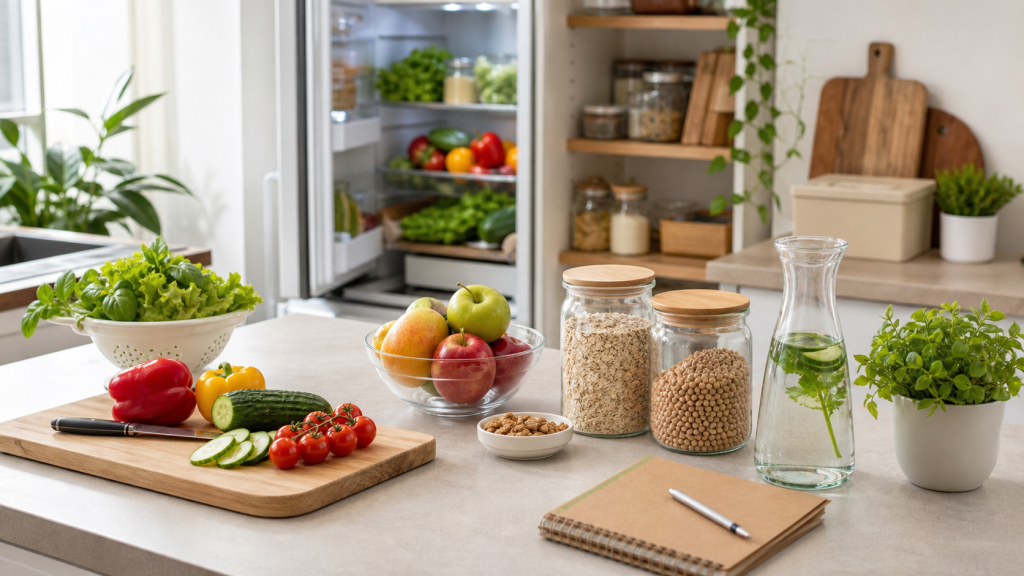
A kitchen reset may sound like housework, but for better eating it is often a practical starting point. Not because a clean kitchen magically creates discipline. It helps because chaos makes choices harder. When the counter is full, the fridge is unclear and snacks sit at eye level, every meal asks you to fight your own environment.
For people who already feel overstimulated at home, a kitchen reset is not about perfection. It is environment design. You make the desired choice more visible, faster and less dependent on willpower. You do not need to fix the whole house. Start where eating happens: pantry, fridge, shopping list, meal prep space and the triggers that keep pulling you into grazing.
The Dutch Nutrition Centre advises checking your stock and making a shopping list as part of smart food planning. It also gives practical guidance for fridge, freezer and pantry storage, including keeping the fridge around 4 degrees Celsius and placing products with the shortest shelf life toward the front. Behavioral nutrition literature points in the same direction in broader terms: what is available, visible and easy can influence eating behavior. A kitchen reset is not a character test. It is a way to make your home work less against you.
A kitchen reset starts with fewer decisions
A kitchen reset works best when the goal stays small: fewer decisions at stressful moments. Most people do not eat chaotically because they lack information. They eat chaotically because the day is full, work runs late, family life is noisy, dishes are still there and the fastest option wins. In that moment you are often losing to friction, not to hunger.
First make the counter usable. Remove mail, keys, unused appliances and loose packaging. Keep only what helps normal meals: cutting board, knife, water, fruit bowl, perhaps coffee or tea. If cutting vegetables takes three minutes of setup instead of fifteen minutes of searching, cooking becomes less heavy.
A kitchen reset does not need a free Saturday. Set a timer for ten minutes. Throw away visible rubbish, move dishes, clear one piece of counter and place the cutting board where it is easy to use. Then stop. The point is not that everything is finished. The point is that your next meal has less resistance than your last meal.
Make your pantry honest
A pantry is not a museum of good intentions. A kitchen reset means seeing what you actually use. Empty one shelf and make three groups: base foods, emergency meals and triggers. Base foods include oats, wholegrain pasta, brown rice, legumes, canned tomatoes, tuna, herbs, nuts and other ingredients that can quickly become a normal meal.
Emergency meals are not perfect, but they are better than ordering food because you are frustrated. Think soup, beans, frozen vegetables, wholegrain wraps, eggs, yoghurt, rice, pasta or canned fish. The Dutch Nutrition Centre also describes shelf-stable foods as useful in unexpected situations. For weight loss, that simple base matters because you fight snack urges less often with an empty kitchen.
Triggers are personal. For one person it is crisps and biscuits. For another it is breakfast cereal, chocolate spread or salted nuts. A kitchen reset asks for honesty without drama. You do not need to ban every treat. But if a food disappears every evening when you did not want that, it has not earned an eye-level place. Put it higher, behind a door, in smaller portions or buy it less often.
Use a kitchen reset for the fridge
A kitchen reset in the fridge is not about pretty containers. It is about visibility and safety. Put foods that need to be eaten first at the front. Create one shelf or box for leftovers. Keep vegetables and fruit in predictable places. Put protein sources such as yoghurt, eggs, chicken, tofu or legumes where they can easily become part of a meal.
The Dutch Nutrition Centre advises chilling perishable foods properly and setting the fridge to 4 degrees Celsius. It also advises placing foods with the shortest shelf life toward the front and storing vegetables in the vegetable drawer. These are not glamorous systems, but they prevent two common problems: food waste and the useless thought that there is nothing to eat.
Do a fridge reset before shopping. Throw away spoiled food, move open products forward and write down what needs to be used. The shopping list then becomes more realistic. A kitchen reset saves not only calories, but also money and irritation. You buy fewer duplicates and see faster which meal makes sense today.
Put healthy defaults in sight
People often overestimate how much conscious control they use in the kitchen. After a long day, you take what you see. A kitchen reset is therefore also about moving choices. Put fruit in sight when the product can be stored that way. Keep water or tea easy. Give wholegrain bread, oats or legumes a fixed place. Make sweets and snacks less prominent.
This is not a childish trick. Studies on food environments and choice architecture show that availability, portion size, visibility and convenience can influence food choices. You do not need to control everything. You can simply accept that a bowl of biscuits on the table has more influence than a motivational note on your phone.
A good default is a choice that almost happens by itself. A bottle of water on the table. Cucumber ready for lunch. Frozen vegetables beside the wok pan. A list of three quick dinners inside a cupboard door. A kitchen reset makes those defaults easier to find when your energy is low.
The shopping list connects plan and home
A kitchen reset without a shopping list is only half the job. Your environment truly changes when different food enters the house. Check pantry, fridge and freezer first. Then write meals, not only products. For example: yoghurt with fruit, wholegrain bread with egg, pasta with tomato and tuna, rice with vegetables and chicken, soup with beans.
Use a fixed structure: vegetables and fruit, protein, wholegrain base, dairy or alternative, fats and flavor, emergency meals. That prevents you from coming home with random healthy items that do not become dinner. A kitchen reset then improves logistics: every item has a role before it enters the house.
Try not to shop hungry and aimless when you can avoid it. Shopping is also environment design. If you do not want to eat snacks at home but buy them automatically every week, do not expect your evening self to be stronger than your supermarket self. Make the wanted choice earlier in the chain.
Meal prep without bodybuilding boxes
Many people dislike meal prep because they imagine ten identical boxes of chicken and rice. That is not required. A kitchen reset for meal prep simply means you have a clear place to do two or three things ahead. Wash salad, cook rice, prepare extra chicken, cut peppers, make overnight oats or put soup in the fridge.
Prep components, not a prison sentence. When base items are ready, you can still vary meals without starting from zero every time. Cooked potatoes can become salad, omelet side or dinner. Beans can go into soup, wraps or rice. Cut vegetables can work in lunch or dinner. A kitchen reset keeps those components visible and reachable.
Choose a moment that already exists. Twenty minutes after shopping. Extra rice while cooking. Only breakfast prep on Sunday. Good prep is small enough that you can repeat it in a messy week. You win because two poor decisions no longer need to be made from scratch.
Reduce triggers without making the house strict
A kitchen reset often becomes too strict. All treats disappear, and three days later everything comes back. A better approach is to limit triggers. Buy smaller packages. Use one snack drawer instead of snacks across the house. Separate portions. Decide when something fits deliberately.
Also look beyond the kitchen. Sweets next to the couch, biscuits beside the laptop and soda near the bed make grazing feel normal. Move food back to the kitchen or dining table. Not as punishment, but because sitting down with a plate or bowl gives you more choice than eating from packaging.
For some people, stress eating, binge eating or shame plays a bigger role. Then a kitchen reset can support you, but it is not treatment. Speak with a dietitian, doctor or psychologist if eating feels uncontrollable or your health is suffering. Environment helps, but serious problems do not need to be solved alone by tidying.
A ten minute plan for today
Start today with a small kitchen reset. Step one: clear a piece of counter where you can cut food. Step two: put water, fruit or vegetables where you see them. Step three: choose one shelf or box for food that needs to be eaten first. Step four: move your strongest trigger out of direct sight. Step five: write three meals you can make with current stock.
Then stop. Do not clean every cupboard, do not reorganize until midnight, and do not buy a new system. A kitchen reset should give energy, not prove that your life is finally under control. Tomorrow you can repeat ten minutes, do another kitchen reset, or use the cleared space to actually cook.
Measure it by behavior, not perfection. Did you make a normal lunch because the ingredients were ready? Was dinner easier because the pan and cutting board were available? Did you choose a snack instead of automatically grabbing it? Then your environment already worked better.
Conclusion
A kitchen reset is not a moral assignment and not a recycled self-help quote. For FitterVitaal it is practical environment design. You make normal meals easier, triggers less dominant and shopping less random. That is exactly what people need when home already feels chaotic.
Start with the counter, fridge, pantry and shopping list. Put nourishing base foods in sight, store food safely and create a small meal prep space. Use the Dutch Nutrition Centre guidance as a sober baseline and treat behavioral science as support, not a miracle.
The best kitchen is not perfectly clean. The best kitchen makes the next good choice easier than the previous unhelpful habit. A kitchen reset is a calm way to make healthier eating less dependent on motivation. Combine a kitchen reset with simple baseline habits such as drinking water and enough protein in normal meals; for practical options, read protein snacks. That keeps a kitchen reset connected to behavior, not cleaning perfection. When you get stuck, return to a ten minute kitchen reset and repeat the kitchen reset before shopping.
Sources
- Dutch Nutrition Centre: buying, cooking and storing
- Dutch Nutrition Centre: organize your stock
- Dutch Nutrition Centre: storage tips for fridge, freezer and pantry
- Dutch Nutrition Centre: safe chilling and storing
- Review: home food environment and diet quality
- Review: local food environment and diet


