
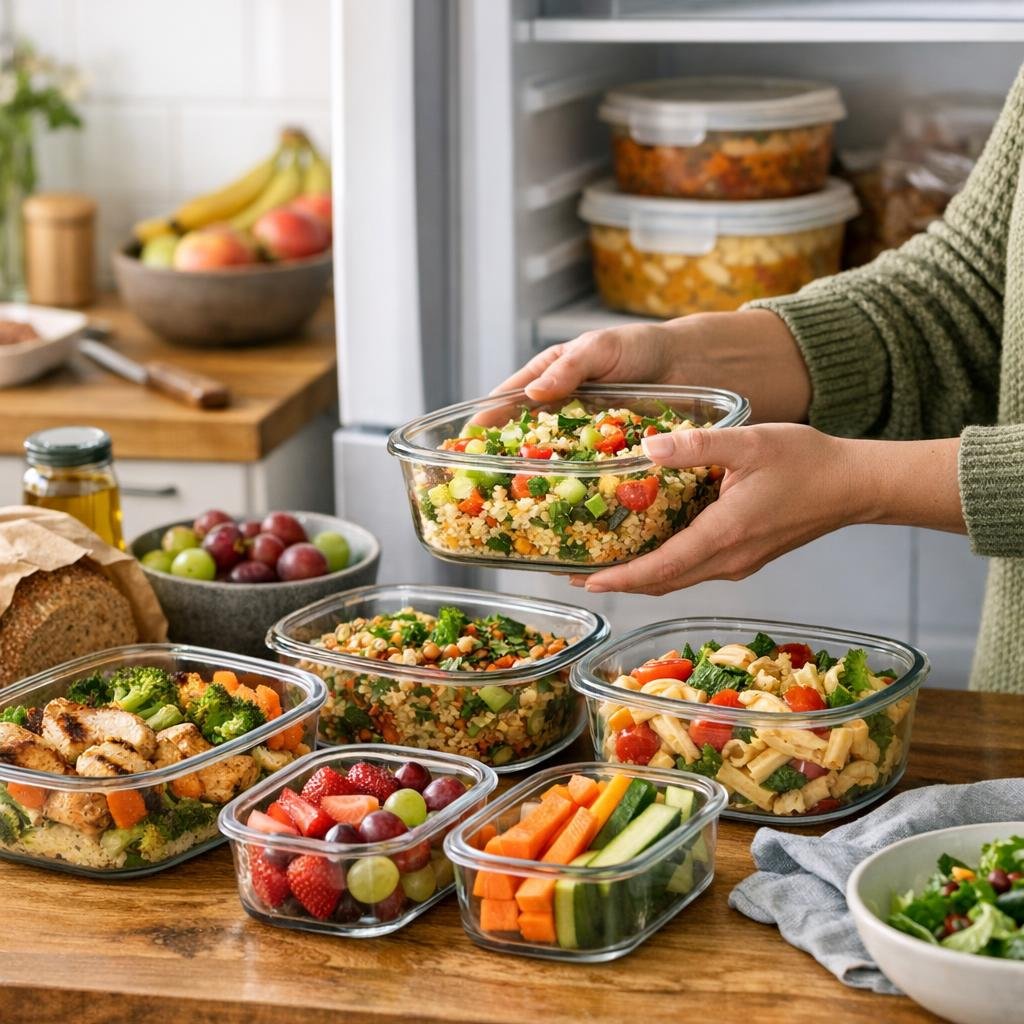
Meal prep sounds like a fridge full of identical containers with rice, chicken and broccoli. Useful for bodybuilders perhaps, but not always for a normal household with work, children, social plans, changing appetite and days when nobody wants to cook.
The better version is much simpler: make things easier before the busy moment arrives. Not by calculating every meal perfectly, but by preparing a few good choices in advance. Then you do not have to decide between cooking, ordering food or snacking at 6:15 p.m. while hungry.
Meal prep for normal people is not about perfect eating. It is about fewer bad decisions when you are tired.
Why meal prep works
Many food choices go wrong because of timing. Not because you know nothing about healthy eating, but because you start too late. You get home, the fridge is half empty, your workday ran over and the supermarket feels like too much effort. At that moment, convenience usually wins.
Meal prep moves part of the decision to a calmer moment. You do not have to plan the entire week in detail. You only need enough structure so the easy choice is also a reasonable choice.
The Dutch Nutrition Centre, Voedingscentrum, recommends the Wheel of Five as a healthy basis: plenty of vegetables and fruit, whole grains or potatoes, protein sources such as legumes, eggs, fish, meat, dairy or alternatives, soft or liquid fats and mainly water, tea or coffee without sugar. Meal prep is not a separate diet. It is a way to make that basis more realistic.
Think in building blocks, not perfect containers
The mistake many people make is trying to prepare five complete meals at once. It looks organised, but in real life it often becomes boring quickly. By day three you no longer want the same meal. By day four plans change. By day five you wonder whether it is still good.
Work with building blocks instead:
- a pan of rice, wholegrain pasta, potatoes, couscous or bulgur;
- a container of roasted or chopped vegetables;
- a protein base such as chicken, eggs, tofu, beans, lentils, tuna, low-fat quark or hummus;
- a simple sauce or flavour base;
- something fresh or crunchy, such as cucumber, tomato, lettuce, pickles or raw vegetables.
The same base can become several meals. Rice with vegetables and beans becomes a quick bowl. Wholegrain pasta with vegetables and tuna becomes lunch. Potatoes with egg and salad become dinner. You are not eating the exact same thing every day, but you are also not starting from zero every day.
Sunday does not need to become a cooking marathon
Meal prep often fails because people turn it into a big project. Three hours of cooking, twenty containers, a destroyed kitchen and a lost Sunday. That only lasts if you truly enjoy it.
For most people, 45 to 75 minutes is more realistic. Choose no more than three actions:
- cook a double portion of dinner;
- chop vegetables for two days;
- make a pan of soup, chilli, curry or pasta sauce;
- boil eggs;
- prepare breakfast for two mornings;
- make a grocery list for three fixed meals.
If all you do is cook extra dinner for tomorrow, that is already meal prep. If you only prepare Monday lunch, that counts too. The standard does not need to be impressive. It needs to work.
Leftovers are not failure
Leftovers are often treated as something accidental. It works better to plan them on purpose. On Monday, cook four portions of something that reheats well. Two portions are dinner, one is lunch and one goes into the freezer.
Voedingscentrum advises cooling leftovers quickly and putting them in a sealed container in the fridge or freezer within 2 hours. According to Voedingscentrum, meal leftovers keep for 2 days in the fridge and about 3 months in the freezer. Store leftovers covered and do not use your senses as an excuse to keep higher-risk foods around for far too long.
In practice:
- label freezer containers with date and contents;
- place leftovers that need to be eaten first at the front;
- create one fixed fridge spot for opened products and leftovers;
- freeze individual portions, not only huge boxes;
- plan one leftovers meal per week.
This saves more than time. It also stops you buying new food while there is already food waiting to be used.
Build a grocery rhythm
A healthy week starts before the kitchen, not in it. Without a plan, people often buy loose good intentions: some vegetables, some yoghurt, some meat, something on offer. At home, it turns out not to be a meal.
For reducing food waste, Voedingscentrum recommends checking your pantry, fridge and freezer before shopping, making a weekly menu and writing quantities on your grocery list. That sounds formal, but it can be very simple.
Use a fixed basic list:
- 2 to 3 vegetables for hot meals;
- 1 to 2 raw vegetable options;
- 2 protein sources;
- 1 to 2 carbohydrate bases;
- fruit for snacks;
- breakfast basics;
- one emergency meal from the pantry or freezer.
An emergency meal is not failure. Think wholegrain wraps with beans and vegetables, soup from the freezer, an omelette with bread and salad, or wholegrain pasta with tomato sauce and tuna. The goal is that ordering food is not the only easy option.
Meal prep for busy households
In a household, meal prep works better when you do not force everything into separate fitness containers. Families eat differently. Someone wants extra sauce, someone dislikes onion, someone arrives home later. Building blocks give more freedom.
For example, prepare:
- a large container of cooked potatoes;
- a pan of tomato sauce with vegetables;
- chicken, tofu or beans separately;
- washed and chopped raw vegetables;
- wraps or wholegrain bread as backup.
Then one person can make a wrap, another can eat pasta and a third can build a simple salad. You are not cooking three separate meals, but you are not forcing everyone into the same box either.
Meal prep and weight loss
Meal prep can help weight loss because it lowers friction. You have to improvise with hunger less often. Portions become more visible. You have fewer reasons to use quick snacks as meals.
But meal prep does not automatically make food low in calories. A large bowl of pasta with lots of oil, cheese and sauce is still energy dense. Nuts, peanut butter, oil, cheese and sauces can fit in a healthy diet, but they add up quickly. Use them deliberately.
A practical plate structure helps:
- plenty of vegetables;
- a clear protein source;
- a suitable portion of whole grains, potatoes or legumes;
- flavour without letting sauce take over the meal.
If you want to lose weight, do not only look at what sounds healthy. Also look at portions, snacks, drinks and weekend habits. Meal prep is a tool, not a free pass.
Start with three moments
You do not need to plan seven days. Start with three moments where things usually go wrong:
1. Monday morning breakfast.
2. Tuesday lunch.
3. Thursday dinner.
Prepare one simple answer for each. Overnight oats or quark with fruit. A leftover lunch. Soup from the freezer with wholegrain bread. If those three moments improve, you already win.
Then you can expand. Not because everything has to be perfect, but because you learn where preparation actually solves a problem.
Common mistakes
The first mistake is trying to do too much. Start with two lunches or one double dinner.
The second mistake is seasoning everything in one container. Sauce, dressing and crunchy parts often keep better separately.
The third mistake is ignoring storage time. Not everything needs to sit in the fridge for five days. Use the fridge for the short term and the freezer for later.
The fourth mistake is making dry, boring meals. Normal food needs flavour. Herbs, lemon, yoghurt, mustard, tomato sauce, chilli paste, vinegar and fresh toppings can do a lot without making the meal heavy.
The fifth mistake is using meal prep as punishment. If you trap yourself with food you dread eating, you will still order something else. Prepare food you actually want to eat.
FAQ about meal prep
Do I need to prepare everything on Sunday?
No. You can cook double on Monday, freeze soup on Wednesday or prepare tomorrow's lunch every evening. Choose the rhythm that fits your week.
How long can I keep leftovers?
Voedingscentrum advises keeping meal leftovers covered in the fridge for no more than 2 days. If you want to store them longer, freeze them. Put leftovers in a sealed container in the fridge or freezer within 2 hours.
Is meal prep required for weight loss?
No, but it can help. Weight loss depends on your energy balance over time. Meal prep makes normal portions and better choices easier to repeat on busy days.
What if my household does not want the same meals?
Use separate building blocks instead of complete containers. Everyone can combine things differently while the base is already ready.
Conclusion
Meal prep for normal people is not a strict fitness ritual. It is simply thinking ahead for the moments when you usually make worse decisions. A double dinner, chopped vegetables, a freezer meal and a fixed grocery list can already be enough.
Start small. Prepare food you actually like. Use leftovers on purpose. Keep the fridge safe and organised. Then meal prep becomes less of an extra project and more of a calm system that makes your week lighter.


