
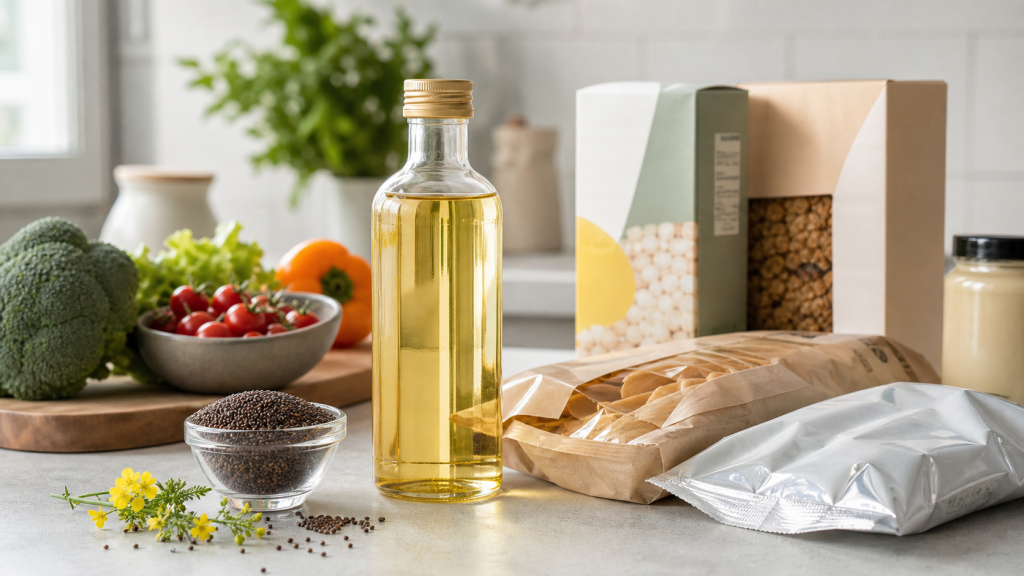
Rapeseed oil appears on labels far more often than most people notice. You see rapeseed oil in crackers, sauces, margarines, ready meals, vegan products, spreads, crisps, biscuits, dressings, hummus, meal salads and baked goods. It is not a tiny detail. Rapeseed oil is cheap, neutral and technically useful for manufacturers, so it slips into many eating moments without feeling like a deliberate choice.
At FitterVitaal, we take rapeseed oil seriously, but we keep the argument honest. The best reason to watch this oil is not that a normal amount is instantly poisonous. That is too simple. The real problem is that rapeseed oil often travels with ultra-processed foods, extra calories, salt, fast carbohydrates and a diet where you make fewer conscious choices. If you eat many processed products, rapeseed oil can act as a signal: this product may contain more hidden energy and less nutritional quality than you think.
That makes this oil worth tracking. Not because every drop deserves panic, but because repetition matters. A little rapeseed oil in a dressing is different from rapeseed oil in crackers, sauce, a meat replacement, a snack, a biscuit and dinner on the same day. Your personal intake does not only come from a bottle on the counter. It comes from all the small products together.
Rapeseed oil: why it is in so many foods
The oil is popular because it is industrially practical. The flavour is mild, the colour is light, the price is attractive and the oil mixes easily with other ingredients. Manufacturers can use rapeseed oil in cold sauces, spreads, baked goods and snacks without making the product taste strongly of oil. To the consumer, the product mainly tastes like herbs, salt, sugar, cheese, tomato, garlic or flavouring. The rapeseed oil stays in the background.
That makes this oil commercially useful. A stronger oil, such as extra virgin olive oil, changes the flavour. Butter is more expensive, contains more saturated fat and behaves differently in production. Coconut fat and palm fat create another texture and bring a different public image. Rapeseed oil sits in the middle: neutral enough for many recipes and affordable enough for large-scale production.
There is also a nutrition argument. Rapeseed oil is relatively low in saturated fat and high in unsaturated fats. Public health organisations often explain that replacing saturated fat with unsaturated fat can support healthier LDL cholesterol. That makes this oil look better on paper than hard fats. But that fat profile does not automatically turn every product with rapeseed oil into a healthy choice.
A biscuit with rapeseed oil is still a biscuit. A sauce with rapeseed oil can still be calorie dense. A meal salad with a heavy dressing can climb quickly. The ingredient may be technically defensible while the total product remains easy to overeat.
How rapeseed oil is made
Rapeseed oil starts with seeds from the rapeseed plant. The seeds are cleaned, crushed or flaked and then heated or conditioned so the oil releases more easily. Part of the oil is mechanically pressed out. In much industrial production, oil remains in the seed cake after pressing. That remaining oil can be extracted with a solvent, commonly hexane, and the solvent is then removed.
The crude oil is not yet ready for many supermarket products. Refined oil is usually processed further through degumming, neutralising, bleaching and deodorising. This is often called RBD: refined, bleached and deodorized. The goal is a stable, neutral oil with little smell, little flavour and predictable colour. That is exactly what makes rapeseed oil useful in mass production.
Cold-pressed oil is different. It is mechanically extracted with less intensive processing and often has more flavour. You are more likely to buy that type of rapeseed oil deliberately as a bottle for home use. The oil in many processed products is usually refined, because manufacturers want neutrality and shelf stability.
This distinction matters. When people talk about this oil, they often mean three things at once: the plant, the cold-pressed oil in a bottle and the refined oil in industrial food. For personal intake, the last category often matters most because it is easy to consume without measuring.
From rapeseed to canola and low erucic acid
This oil has a history with erucic acid. Traditional rapeseed varieties could contain high levels of erucic acid. Modern edible rapeseed and canola oil come from low-erucic-acid varieties. In the United States, the FDA defines low erucic acid rapeseed oil as oil with no more than 2 percent erucic acid in the fatty acids. EFSA has set a tolerable daily intake for erucic acid and concluded that average exposure is not a safety concern for most consumers, while high exposure in young children deserves attention.
This means two things at the same time. First, modern edible oil is not the same as older industrial rapeseed oil with high erucic acid levels. Second, it is still an ingredient where regulation, refining and total exposure matter. It is wiser to take labels and quantities seriously than to pretend none of it matters.
For adults, the biggest practical issue is usually not erucic acid. It is dietary pattern. This oil is often found in products that are eaten quickly, stacked easily and not recognised as a fat source. That can push your total fat and calorie intake higher than expected.
Why rapeseed oil makes intake invisible
If you put a tablespoon of oil in a pan at home, you see what you used. With this oil in processed food, you do not. You may taste crispness, creaminess or softness, but not the amount of oil. That is what makes this oil tricky in practice.
A tablespoon of oil roughly contains about 90 to 120 kcal, depending on the amount. That is normal for fat: fat is energy dense. The problem is not that fat is bad. The problem is that hidden fats are harder to regulate when they sit inside snacks, sauces and soft foods. You often notice only when your daily total climbs.
Take an ordinary day. Crackers with spread, a ready-made lunch salad, a sauce with dinner and a handful of crisps may all contain rapeseed oil. Each product seems small on its own. Together they become a pattern. The oil is then no longer a single choice. It is a recurring background calorie.
That is why it is useful to recognise this oil on labels. Not to become afraid, but to see how often the same fat source appears.
The bigger problem is often the product around it
This oil gets a lot of criticism because it is a seed oil. Some of that criticism goes too far. Omega-6 fats are not automatically bad; linoleic acid is essential, and replacing saturated fat with unsaturated fat can be beneficial. Harvard describes canola oil as low in saturated fat and high in monounsaturated fat.
But the other side can also make the issue too easy. An oil can contain useful fatty acids and still appear in foods you should not eat too often. The health value of your diet is not determined by one ingredient on paper. It is determined by the total pattern: calories, protein, fibre, micronutrients, satiety, portions and repetition.
Our practical line is this: this oil is not the only problem, but it is often a warning light for processing. If you see this oil together with sugar, salt, flavourings, starches, coatings or many additives, look at the full label. Do not only ask whether this oil is bad. Ask what kind of product this is and how often you eat it.
Oxidation, heating and frying
This oil is often chosen because it is reasonably stable for cooking and food processing. Still, heating matters. Oils can oxidise at high temperatures, especially during long or repeated heating. Frying oil that is used for a long time is different from a small amount of oil in a pan.
At home, this means using oil normally, avoiding smoking pans and not reusing oil endlessly. With processed foods, you have less control. You do not always know how often an oil was heated, how long the product has been stored or exactly how it was produced. That is not a reason for panic, but it is a reason not to make heavily processed fried snacks a daily foundation.
This oil in a cold dressing is therefore not the same as rapeseed oil in a fried snack. Context matters. If everything gets treated as the same issue, the most important question disappears: how much processed and heated food is in your week?
Personal intake matters more than internet arguments
The online debate about rapeseed oil is often black and white. One side calls rapeseed oil toxic. The other side says it is healthy because it contains unsaturated fats. For your body, that argument matters less than your real week.
Do you mostly eat normal foundation foods, cook most meals yourself, use a little oil occasionally and get enough vegetables, fruit, legumes, whole grains, protein sources, nuts and fish or other omega-3 sources? Then a small amount of rapeseed oil is probably not your main problem.
Do you eat many crackers, sauces, snacks, ready-made meat replacements, biscuits, crisps, dressings and ready meals? Then rapeseed oil is a marker for something bigger: a lot of energy from products that are easy to keep eating. You do not only need to remove rapeseed oil. You need to shrink the processed-food layer of your diet.
That is the sober reason to pay attention to rapeseed oil. Not because it is magically harmful, but because it often shows where hidden fat and convenience enter your food pattern.
How to spot this oil on labels
On English labels you may see rapeseed oil, canola oil, vegetable oil or low erucic acid rapeseed oil. On Dutch products you may see raapzaadolie or koolzaadolie. Sometimes the label says "vegetable oils (rapeseed, sunflower)" or "oils in varying proportions". Also check margarines, cooking fats, vegan spreads and sauces. Rapeseed oil may form a large part of the fat profile.
Ingredient order helps. Ingredients are listed by weight. If rapeseed oil appears near the front, it is a major part of the product. If it appears near the end, the amount is probably smaller. But small amounts can still add up when several products are eaten on the same day.
Then check the nutrition table per 100 grams and per serving. Fat, saturated fat, calories, salt and fibre are especially useful. A product with rapeseed oil plus fibre, protein and little salt is different from a product with rapeseed oil, little fibre, lots of salt and high energy density.
Practical rules for less rapeseed oil
You do not need perfect eating. Start with products where rapeseed oil mainly adds convenience and extra calories.
- Choose simple foundation foods with shorter ingredient lists more often.
- Make sauces and dressings yourself more often, so you can dose oil.
- Use hummus, spreads and vegan products consciously; check portions.
- Limit snacks where oil is central, such as crisps and fried products.
- Compare crackers, wraps and spreads on calories, fibre and fat.
- Use a spoon at home instead of pouring straight from the bottle.
- Vary fat sources: olive oil, nuts, avocado, fatty fish, seeds and whole foods.
- Count oil in the FitterVitaal calorie need tool or in your nutrition app.
These rules are not only about rapeseed oil. They make your total diet easier to see. That matters more than demonising one ingredient.
What should you choose instead?
For cooking, choose fats that fit the dish and your goal. Extra virgin olive oil is interesting because of flavour and polyphenols, but not every dish needs it. Regular olive oil, avocado oil, a small amount of butter, nuts, seeds and fatty fish can all fit into a normal diet. The point is variety and portion control.
Use oil as an ingredient, not as automatic background. That sounds small, but it changes a lot. If you consciously use a tablespoon of oil in a meal with vegetables, protein and fibre, that is different from unconsciously getting oil from five factory-made products.
If you want to lose weight, this matters even more. Oil is calorie dense and easy to underestimate. For more structure, read our article about the Vytal app and healthy eating. The goal is not fear of fat. The goal is control over portions and patterns.
Conclusion
This oil is not rare and not accidental. It is in so many foods because it is cheap, neutral, stable and industrially convenient. That is exactly why your personal intake deserves attention. Not because one drop of this oil ruins your health, but because this oil often arrives hidden inside processed foods that are easy to overeat.
The smart approach is simple: read labels, recognise rapeseed oil as a recurring ingredient, look at the whole product and especially reduce processed foods where oil, salt, sugar and starch come together. Use fats consciously, measure them at home and do not let your week fill up with industrial background oil.
If you want to reduce rapeseed oil, do not start with panic. Start with overview. Track where rapeseed oil appears for one week. Then you will know which products you truly want to keep and which ones were just habit.
Sources
- EFSA: Erucic acid in feed and food
- EFSA: Erucic acid a possible health risk for highly exposed children
- FDA/eCFR: Low erucic acid rapeseed oil
- Harvard T.H. Chan: Concerns about canola oil
- Voedingscentrum: Omega 6
- Voedingscentrum: Omega 3
- Voedingscentrum: Vetten
- Rijksoverheid: minder zout, verzadigd vet en suiker in voeding


