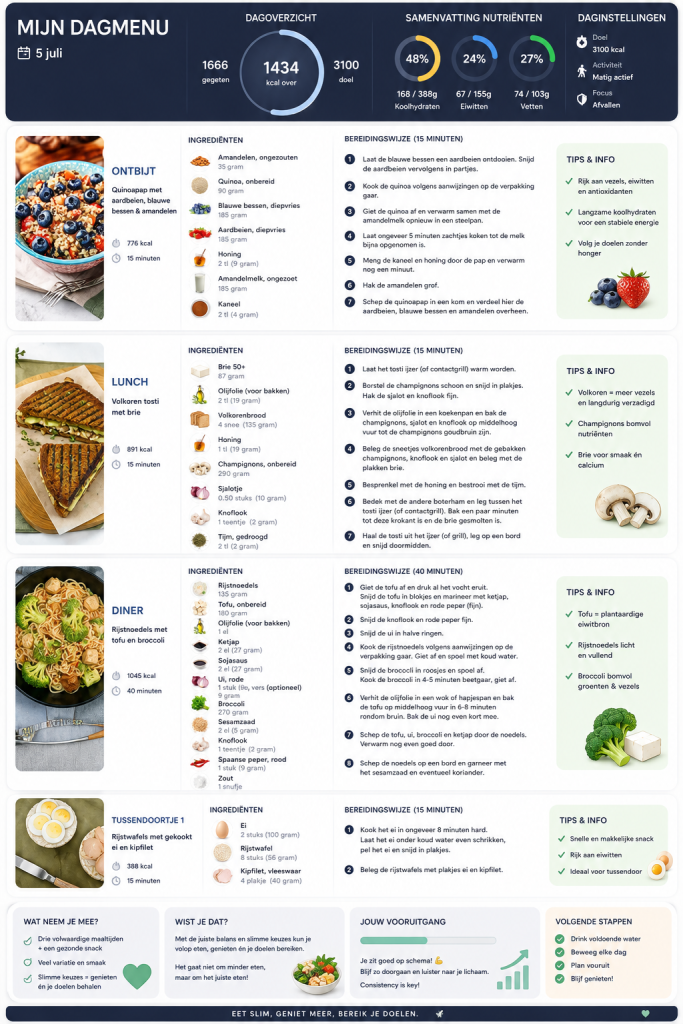
This menu in the Vytal app is a concrete example from my own planning. The image at the top of this article is not something I put together afterwards, but a real snapshot from my app on Sunday 5 July 2026. You can see my daily overview, the dishes, the quantities and the tracker showing that breakfast and lunch had already been checked off.
One important note: this is my personal menu, not a fixed template everyone should copy. Vytal prepares menus for me roughly two weeks ahead, so there is always a menu ready for the coming days. When one day ends, a new day is added. I usually check the coming week on Saturday, review what the app generated, adjust anything that does not fit, create the shopping list and go to the store afterwards. For this day I did not change anything. On other days I sometimes swap dinner, choose a different breakfast or change the full plan. The adjusted menu then keeps the intake aligned with my goal.
That is exactly why I wanted to show it. This menu is not meant to be a strict list with tiny portions. My menu overview includes breakfast, lunch, dinner and a snack. It uses normal dishes, with Vytal recipes, ingredients and clear preparation steps. I did not create the menu myself to make the day look better. I simply followed what the app prepared for me.
The goal of this article is simple: to show what Vytal generated for me on a normal day. My plan includes quinoa porridge with strawberries, blueberries and almonds, a wholegrain toastie with brie, rice noodles with tofu and broccoli and rice cakes with boiled egg and chicken breast. That does not sound like suffering. It is enough food, while I am still working directly on my goals.
My Vytal menu in the app
The menu overview immediately shows how practical the app is. At the top is the daily overview. I can see my target of 3100 kcal, what I have already eaten and how much room is left. I also see the split between carbohydrates, protein and fat. On the right are my day settings: target 3100 kcal, moderately active activity level and a weight-loss focus.
At the moment of the screenshot, I had already eaten breakfast and lunch. The tracker at the top shows that: 1666 kcal eaten and 1434 kcal left. That makes the menu overview honest. This is not a nice promise for later in the day, but a real snapshot of a day I was already following.
What I like is that the menu does not only tell me what to eat. It also tells me exactly how much I need. For breakfast, it lists quinoa, blueberries, strawberries, almond milk, honey, cinnamon and almonds. For lunch, it includes wholegrain bread, brie, mushrooms, shallot, garlic and thyme. For dinner, it lists rice noodles, tofu, broccoli, sesame seeds and seasonings.
Those details make it useful. If someone only says that you should eat healthy, you can go in any direction. With a concrete menu and plan, you know what to prepare, what goes into it and how it fits into the day. A menu then stops being abstract and becomes a practical route to your next meal.
Enjoying food while working on your goal
Many people think weight loss means eating less, eating dry meals or eating the same food every day. This Vytal day shows something else. The day includes warm porridge with fruit, a toastie, a noodle dish and an easy snack. That feels more like normal eating than diet punishment.
That matters, because consistency becomes difficult when you dislike your food. You may be able to force yourself for a few weeks, but eventually you need a rhythm that fits your life. A good menu helps by giving structure without making every meal feel like something is missing. It makes the goal concrete without taking the enjoyment out of food.
Breakfast is substantial: quinoa porridge with fruit and almonds. Lunch is simply a wholegrain toastie with brie. Dinner is rice noodles with tofu and broccoli. The snack is simple: rice cakes with boiled egg and chicken breast. Everything has a role. There is energy, protein, volume and taste.
For me, this is exactly the message I want to share. Working on your goals can be enjoyable. You do not need to become afraid of food. You also do not need to figure everything out yourself when an app can help with recipes, portions and structure.
Precision makes the difference
This day plan works well only when you follow it seriously. That does not mean becoming obsessive. It means being precise enough. While preparing the dishes, I weigh the ingredients so the calorie intake in the app matches what actually ends up on my plate.
That is the core. If the app says my breakfast uses 90 grams of quinoa, I do not make a wild guess. If lunch lists 87 grams of brie, I weigh it. If dinner uses 180 grams of tofu and 270 grams of broccoli, I want to know that my portion is actually close to that.
This removes doubt from the day. You do not need to wonder afterwards whether lunch was much larger than planned. You also do not end up thinking the app does not work while you quietly add extra oil, cheese or nuts every day. The app gives the structure, but you make it reliable by weighing properly.
For many people, weighing sounds excessive at first. In practice, it often creates calm. You learn portions. You see where calories are. You notice which ingredients add up quickly. Over time, that becomes more natural, but in the beginning precise weighing is one of the best ways to get an honest overview.
Generated by Vytal, editable by me
I want to be clear about this: this menu was not composed by me afterwards to make the day look better. These are Vytal dishes, Vytal recipes and Vytal ingredients. The app gave me this day and I followed the instructions. On other days I freely adjust the planning. Sometimes I swap one meal, sometimes I choose another full day menu and sometimes I change the entire day.
That makes the menu example stronger. It shows what someone can actually expect inside the app, including the freedom to make a plan work for a real week. You get dishes, ingredients, quantities, preparation time, preparation steps and tips. So it is not only a calorie calculator. It helps you go from plan to execution.
For breakfast, the preparation time is 15 minutes. Lunch also takes 15 minutes. Dinner takes 40 minutes. The snack takes 15 minutes. That helps you plan the day better. If you know dinner takes a bit longer, you can take that into account.
The tips next to the dishes are useful too. They briefly explain why a meal works: fibre, protein, slow carbohydrates, plant-based protein sources, vegetables and easy snacks. That makes the menu overview less abstract. You do not only see what you eat, but also why it fits the day.
More food than you might expect
One striking point about this menu is the amount of food. People who want to lose weight often assume they need to be hungry. But this day includes three full meals and a snack. The total day is matched to my goal and my activity.
That is very different from randomly eating less. If you simply skip meals or halve portions, hunger, cravings and frustration often follow. If you follow a well-built menu, you can still eat with direction without every day feeling like deprivation.
Of course, that does not mean everyone needs 3100 kcal. This menu fits my personal setting. Someone else can have a different goal, different body weight, different activity level and different portions. That is exactly why personalisation matters.
The principle stays the same: enough food within your goal. No guessing. No starving yourself. No same boring plate every day. A plan should fit your settings, preferences and progress.
Weekly planning, shopping and cooking become concrete
A menu in Vytal becomes truly useful when it also helps with shopping and cooking. That is why I check the week ahead on Saturday. In this overview, every dish shows exactly which ingredients are needed. That makes the step to the supermarket smaller. You are not buying random healthy foods and hoping they turn into meals later. You buy what you need.
That also helps prevent waste. If a dish uses 290 grams of mushrooms, you know what you need. If dinner includes broccoli, tofu, rice noodles, ketjap and sesame seeds, you can prepare with purpose. The shopping list can include the number of people, so quantities better match the real situation.
For me, this is one of Vytal's strongest points. I finish the menu planning, create the shopping list and buy the ingredients that same day. Many people already know they want to eat healthier. The hard part is execution: what do I cook, how much do I need, how does it fit my day and how do I avoid ordering something easy anyway? A concrete menu with a shopping list removes a lot of friction.
That is also why I wanted to show this real Vytal menu. It is not about perfect marketing photos. It is about a system that makes daily choices easier.
Handling your menu honestly
An app can do a lot for you, but not everything. A menu overview works best when you enter and follow things honestly. Extra oil in the pan, a handful of nuts, a larger slice of cheese or an extra sauce may seem small, but over a week they can make a real difference.
That is why I keep coming back to weighing and preparing precisely. Not because food should become a maths lesson, but because goals need measurement. If your goal is weight loss, you want to know that your calorie intake is accurate. If your goal is muscle retention or performance, you want to know that your protein and energy make sense.
That precision actually makes the process feel freer. You doubt less. You compensate less. You see what happens and can adjust based on data. That is much better than staying stuck in guesswork and getting frustrated. For me, the menu mainly works as a practical measuring stick. The app shows the intention, and the scale helps me carry it out.
FitterVitaal is not about being strict for the sake of it. It is about doing what works. For me, that means following the instructions, weighing ingredients, eating the menu and watching how my body and progress respond.
What you can take from this example
You do not need to copy my menu exactly. The value is in the example. You can see that a goal-oriented Vytal day can still be tasty, normal and generous. You can also see that structure does not need to be boring.
Take these lessons from it:
- a good menu can taste good and still fit your goal;
- breakfast, lunch, dinner and a snack can all be part of weight loss;
- precise weighing makes the app more reliable;
- Vytal recipes give more guidance than loose calorie numbers;
- personalisation helps with allergies, preferences and family situations;
- a shopping list makes execution easier, especially when you plan the week ahead;
- you can adjust meals or full days without recalculating everything yourself;
- working on your goals can stay enjoyable.
If you want to know how the app works, also read my explanation of the Vytal app through FitterVitaal. If you first want to estimate your own starting point, you can use the FitterVitaal calorie need tool.
Conclusion
This menu shows exactly what I want to communicate. Working on your goals does not need to mean eating little, boring or tasteless food. With the right structure, you can eat well, eat enough and still keep direction.
For me, the strength was simplicity: Vytal generated my menu, I followed the instructions and weighed the ingredients. That means I know what I eat matches what the app records. That gives peace of mind.
The Vytal app is therefore not only a place to count calories. It is a practical way to bring recipes, ingredients, portions, shopping and goals together. This day plan is only one example, but it is a real example from my own day. That is exactly why I wanted to share it.


