
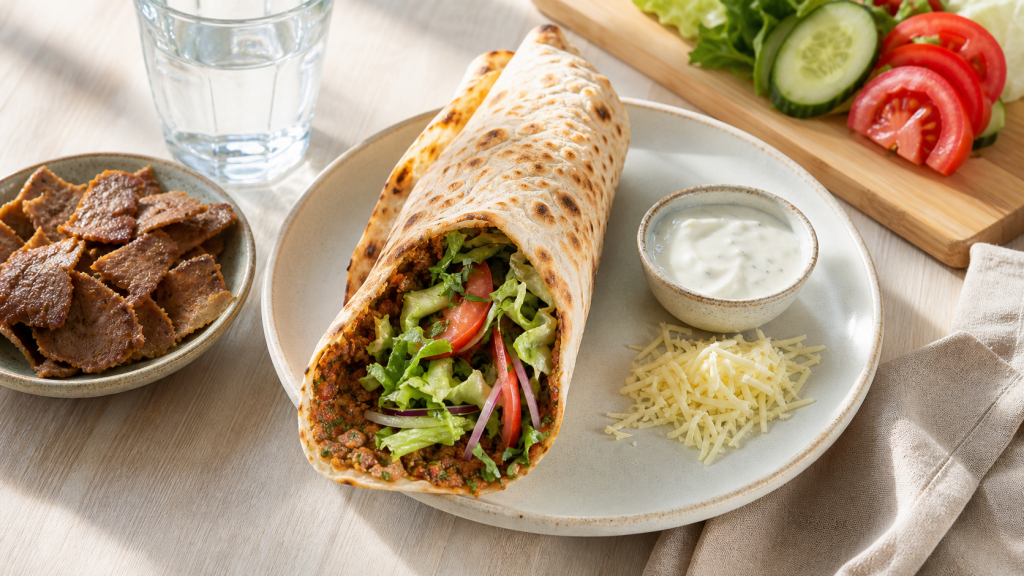
Turkish pizza calories look simple when you only think about the thin base. Lahmacun is not a thick Italian pizza covered with cheese. Still, the same takeaway order can change a lot once garlic sauce, cheese, salad and doner are added. A simple Turkish pizza can quickly become a full meal.
At FitterVitaal, we look at Turkish pizza calories without banning takeaway food. A Turkish pizza can fit perfectly well when you understand the eating moment. The difference is in the base, sauce, cheese, meat and anything you drink or order with it. When you see those parts separately, you do not need to guess as much.
The short version: the Dutch Nutrition Centre lists 1 piece of Turkish pizza base of 50 grams at 102 kcal, with 1.9 grams of fat, 16.8 grams of carbohydrates, 3.8 grams of protein and 0.85 grams of salt. That is the thin base, not automatically the whole filled takeaway wrap. A 25 gram sauce spoon of garlic sauce contains 62 kcal, and a richer 35 percent oil garlic sauce contains 94 kcal. Cheese and doner can add clearly on top.
Turkish pizza calories: the quick build-up
Turkish pizza calories become clearer when you see the order in layers. First there is the base with seasoned minced meat or tomato-herb topping. Then salad and vegetables. Then sauce. Sometimes cheese. In many snack bars you can also add doner or shoarma-style meat.
| Component | Sourced portion | Kcal | Practical meaning |
| --- | ---: | ---: | --- |
| Turkish pizza base | 50 g | 102 kcal | thin base, not the whole filled wrap |
| Garlic sauce | 25 g | 62 kcal | 1 sauce spoon; extra sauce counts quickly |
| Garlic sauce, 35% oil | 25 g | 94 kcal | richer sauce variant |
| Mature 48+ cheese | 30 g | 113 kcal | about 1 pre-sliced cheese slice |
| Pork shoarma meat | 100 g | 146 kcal | useful anchor for meat add-ons |
| Chicken/turkey shoarma meat | 100 g | 109 kcal | lighter meat anchor according to the Dutch Nutrition Centre |
This table does not mean every takeaway shop works exactly like this. It does show why Turkish pizza calories can climb quickly. Sauce and cheese alone can add 175 to more than 200 kcal. A generous meat layer can add another 100 to 200 kcal depending on type and amount.
Nutrition databases also show that lahmacun varies strongly. FatSecret lists lahmacun entries including 162 kcal per 100 grams and 487 kcal per piece. MyNetDiary shows a lahmacun entry of 217 kcal per 100 grams. That variation is exactly why Turkish pizza calories are better viewed in components than as one magic number.
See Turkish pizza calories as a build-up. The plain base gives a starting point, sauce adds a quick extra layer, cheese makes it creamier and doner makes it heavier. When you view Turkish pizza calories this way, the choice becomes more practical and less dependent on guesswork.
Lahmacun is not always the same Turkish pizza
Turkish pizza calories start with what you mean by Turkish pizza. In the Netherlands, lahmacun is usually sold as a thin dough base with seasoned minced meat, onion, tomato and herbs. Sometimes it is very thin. Sometimes it is larger, more richly topped or filled firmly with salad. In snack bars it is often rolled like a wrap.
That makes comparison difficult. A supermarket lahmacun with a label is different from a large takeaway roll with salad and sauce. A 50 gram base from the Dutch Nutrition Centre calorie checker is a clear anchor, but many finished orders weigh more once filled. Salad mostly adds volume. Sauce, cheese and meat add more energy to Turkish pizza calories.
So the best question is not: how many kcal does Turkish pizza always have? The better question is: which Turkish pizza is in front of me? Is it a plain lahmacun, a Turkish pizza with garlic sauce, a Turkish pizza with cheese or a Turkish pizza with doner?
The base is thin, but not free
The base of Turkish pizza often feels light because it is thin. That is partly true. A thin base is usually less energy-dense than a thick pizza with a lot of cheese. Still, the base counts. According to the Dutch Nutrition Centre, 50 grams of Turkish pizza base contains 102 kcal and 0.85 grams of salt.
With Turkish pizza calories, salt is useful context. After takeaway, you may temporarily weigh more because of salt and carbohydrates. That is water, not immediate fat gain. It does say something about the total eating moment: sauce, meat, cheese and side dishes can bring a lot of salt together.
A plain lahmacun with plenty of salad can therefore be a reasonable choice. But if you count it as a tiny snack while it is actually large and filled, your tracking becomes less honest. Use the base as the starting point, not the endpoint for Turkish pizza calories.
Garlic sauce: small cup, big effect
Garlic sauce is often the quiet calorie source. A little sauce can make Turkish pizza more enjoyable, but a generous cup is a separate part of the meal. The Dutch Nutrition Centre lists 25 grams of regular garlic sauce at 62 kcal. Garlic sauce with 35 percent oil contains 94 kcal per 25 grams.
That means Turkish pizza calories can differ a lot under the same sauce name. A thin line of sauce is mostly flavor. Two generous spoons of richer garlic sauce can add almost 200 kcal. Many people do not expect that because sauce is liquid and does not feel very filling.
You do not need to ban garlic sauce. Ask for sauce on the side, choose how much you really want and dip deliberately. If you track Turkish pizza calories, enter sauce separately. That prevents a plain lahmacun entry from looking neat on paper while the real meal was bigger.
Cheese makes it more like pizza
Cheese changes the feeling of the meal. A Turkish pizza with cheese feels fuller, creamier and more like comfort food. That can be worth it, but it changes the numbers. A 30 gram pre-sliced portion of mature 48+ cheese contains 113 kcal, 9.2 grams of fat and 6 grams of saturated fat according to the Dutch Nutrition Centre.
In practice, cheese is not always added as a neat slice. Sometimes it is grated cheese, processed cheese or simply more than you think. That is why Turkish pizza calories with cheese are less predictable than a plain version. Cheese adds energy without much volume.
Make the choice deliberate. If you really want cheese, take it and maybe skip extra sauce or meat. If you mainly want volume, salad gives more volume for less energy. Cheese itself is not the problem. Automatically choosing every add-on and underestimating Turkish pizza calories is.
Doner or shoarma turns it into a large meal
Turkish pizza with doner is a different product from plain lahmacun. You add meat, fat, salt and protein. The Dutch Nutrition Centre does not give one universal doner layer for every snack bar, but shoarma meat is a useful comparison anchor. Pork shoarma meat contains 146 kcal per 100 grams. Chicken or turkey shoarma meat contains 109 kcal per 100 grams.
A shop may use more or less meat. Doner can be fattier or leaner. Preparation and portion size matter a lot. Still, the anchor shows why Turkish pizza calories with doner move toward a meal. If you add 100 to 150 grams of meat, it is no longer a small snack.
This is where many people double-count in their head. They order Turkish pizza with doner as a snack, then eat later as if nothing happened. It works better to treat it as a meal. Then Turkish pizza calories fit much more easily into your day.
Salad helps, but does not make everything light
Salad in Turkish pizza is useful. Lettuce, tomato, cucumber, onion and red cabbage add volume, freshness and chewing. For Turkish pizza calories, salad is usually not the issue.
Still, salad can mislead you. You see vegetables and conclude the whole order is light. But salad sits next to base, meat topping, sauce, cheese and sometimes doner. Vegetables improve a meal, but they do not erase the other components.
Use salad well. Ask for extra salad if you want more volume. Keep sauce separate if you want control. When you are hungry, choose more vegetables more often than extra cheese and extra sauce. That keeps Turkish pizza calories easier to manage without making the meal feel empty. Turkish pizza calories then stay linked to deliberate choices, not automatic extras.
Tracking in Vytal or another app
Tracking Turkish pizza calories gets easier when you stop searching for the perfect entry. Start with the best match: lahmacun, Turkish pizza or Turkish pizza base. Then look at size. Is it a small plain lahmacun, a large roll or a Turkish pizza with doner?
Enter visible additions separately. Garlic sauce separately. Cheese separately. Doner or shoarma separately. Soft drinks, ayran or alcohol separately too. That seems like more work, but it is often more accurate than choosing one random database entry.
In the Vytal app through FitterVitaal you can save a regular takeaway meal as a favorite. Use a realistic estimate the first time, learn from your weekly average and adjust if you order from the same shop often. Perfect accuracy is not required. Consistently honest is better. With Turkish pizza calories, an honest repeatable estimate is usually more useful than choosing an entry that is too low every time.
Can Turkish pizza calories fit weight loss?
Yes, Turkish pizza calories can fit weight loss. Weight loss depends on total energy intake across days and weeks, not one forbidden food. A plain Turkish pizza with salad can be a perfectly reasonable planned takeaway choice. A Turkish pizza with garlic sauce, cheese and doner can also fit, but usually as a real meal.
Use your daily room deliberately. If you want the larger version, keep breakfast and lunch normal but not chaotic. Eat enough protein and vegetables earlier in the day. Drink water or a zero drink if regular soda does not add much value. Skip extra side dishes when the Turkish pizza is already large enough.
To estimate your own room, use the FitterVitaal calorie needs tool. For broader context on Dutch takeaway choices, you can also read our article on how many calories are in a kapsalon, but this Turkish pizza is a different product: thin base first, add-ons after. That is why Turkish pizza calories deserve their own check instead of copying another snack calculation.
Smarter ordering without strict rules
The simplest win is choosing what gets the main role. If you mainly want lahmacun, take Turkish pizza with salad and sauce on the side. If you mainly want meat, take Turkish pizza with doner but see it as a meal and maybe skip cheese or extra sauce. If you mainly want comfort, choose cheese deliberately and keep the rest calmer.
Even more practical: ask for extra salad, sauce on the side, no extra cheese unless you truly want it, and drink water. Share a meat version if you also want something else. Eat slowly; a rolled Turkish pizza can disappear before fullness catches up.
At home or with supermarket products you have more control. Read the label per piece and per 100 grams. Notice the difference between plain lahmacun and a filled wrap. Turkish pizza calories become vague only when every version is treated as the same thing. Keep Turkish pizza calories linked to your real order, not to the smallest database entry.
Common mistakes with Turkish pizza calories
The first mistake is counting only the base. The 50 gram Dutch Nutrition Centre base is a useful anchor, but a filled takeaway roll contains more than base. The second mistake is forgetting garlic sauce. Sauce spoons can add 62 to 94 kcal per 25 grams.
The third mistake is treating cheese as a tiny detail. Cheese can add more than 100 kcal per reasonable portion. The fourth mistake is not counting doner as a meat portion. Meat adds protein, but also energy and salt.
The fifth mistake is eating Turkish pizza as a snack and then still having a full meal. That does not have to be forbidden, but it does need to count. Turkish pizza calories are most useful when you give the eating moment a clear role. Turkish pizza calories become a problem mainly when sauce, cheese and meat stay invisible in your tracking. The clearer that role is, the easier Turkish pizza calories are to manage.
FAQ about Turkish pizza calories
How many calories are in Turkish pizza?
It depends on size and toppings. The Dutch Nutrition Centre lists 102 kcal for 50 grams of Turkish pizza base. Nutrition databases show large differences for lahmacun, such as 162 to 217 kcal per 100 grams and sometimes around 487 kcal per piece. Sauce, cheese and doner come on top, so Turkish pizza calories need the full order.
How many calories does garlic sauce add?
According to the Dutch Nutrition Centre, 25 grams of garlic sauce contains 62 kcal. A richer garlic sauce with 35 percent oil contains 94 kcal per 25 grams.
Is Turkish pizza with cheese much heavier?
Cheese raises Turkish pizza calories. A 30 gram slice of mature 48+ cheese contains 113 kcal according to the Dutch Nutrition Centre. Grated or extra cheese can differ.
Is Turkish pizza with doner a snack or a meal?
Turkish pizza with doner is usually better treated as a meal. The meat adds energy, salt and protein. Do not count it like a plain lahmacun.
Can I eat Turkish pizza while losing weight?
Yes. Choose size and toppings deliberately, count sauce and meat, and avoid automatic stacking with extra snacks or sugary drinks. Then Turkish pizza calories can fit within a normal weekly average.
Conclusion
Turkish pizza calories are not one fixed number. The thin base is fairly clear, but garlic sauce, cheese and doner change the order quickly. According to the Dutch Nutrition Centre, 50 grams of Turkish pizza base provides 102 kcal, 25 grams of garlic sauce 62 to 94 kcal and 30 grams of mature 48+ cheese 113 kcal. Meat can add a clear meal layer on top.
You do not need to avoid Turkish pizza. Give it a clear role: plain lunch, snack with salad or full meal with doner. Ask for sauce on the side, choose cheese deliberately and count meat separately when tracking. Then Turkish pizza calories become normal information instead of a guess.
Sources
- Dutch Nutrition Centre calorie checker: Turkish pizza base
- Dutch Nutrition Centre calorie checker: garlic sauce
- Dutch Nutrition Centre calorie checker: garlic sauce 35% oil
- Dutch Nutrition Centre calorie checker: mature 48+ cheese
- Dutch Nutrition Centre calorie checker: pork shoarma meat
- Dutch Nutrition Centre calorie checker: chicken/turkey shoarma meat
- FatSecret: lahmacun nutrition search
- MyNetDiary: lahmacun Turkish pizza


