
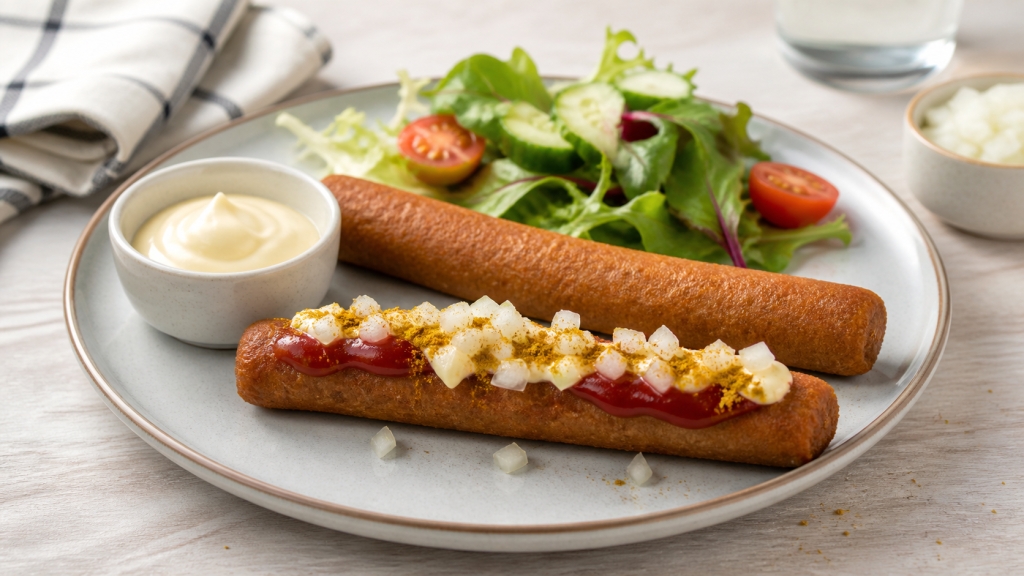
Frikandel calories look simple at first. You eat one snack, log it and move on. In real life, it often becomes less simple. Not because a frikandel is forbidden, but because the details add up quietly. A plain frikandel is different from a frikandel speciaal. A frikandelbroodje, the pastry version, is a completely different product. Two frikandellen during a snack moment can also become a full meal once fries, sauce and drinks join the plate.
At FitterVitaal, we look at this without judgement. A frikandel is not a moral mistake and not a reason to give up your day. It is an energy-dense Dutch snack with a lot of fat and salt, a reasonable amount of protein and little volume. If you want to lose weight or understand your nutrition better, the useful move is to count it honestly. Not strictly, but accurately enough.
The short version: according to the Dutch Nutrition Centre, a fried frikandel of 72 grams contains about 181 kcal. A frikandel of 85 grams is around 200 kcal. A frikandel speciaal of 140 grams contains about 322 kcal. A frikandelbroodje made with puff pastry contains about 474 kcal. Those differences are large enough to affect your daily plan.
Frikandel calories: the quick comparison
Frikandel calories depend mainly on portion size, preparation and toppings. The snack itself is not always the biggest issue in your day. The pattern around it matters: speciaal sauce, extra mayonnaise, pastry, fries, another snack, soft drinks, beer or simply eating a second one because the first felt small.
A practical comparison based on Dutch Nutrition Centre values:
| Product | Portion | Kcal | Fat | Carbs | Protein | Salt |
| --- | ---: | ---: | ---: | ---: | ---: | ---: |
| Fried frikandel | 72 g | 181 kcal | 13.2 g | 4.8 g | 9.9 g | 1.82 g |
| Frikandel | 85 g | 200 kcal | 14.6 g | 5.2 g | 11.1 g | 1.81 g |
| Frikandel speciaal | 140 g | 322 kcal | 23.1 g | 12.9 g | 14.3 g | 2.93 g |
| Vegetarian frikandel | 80 g | 170 kcal | 9 g | 12.3 g | 8 g | 0.98 g |
| Fried vegetarian frikandel | 80 g | 220 kcal | 15.5 g | 11.2 g | 7.3 g | 0.89 g |
| Frikandelbroodje | 145 g | 474 kcal | 30.7 g | 36.8 g | 11.6 g | 1.9 g |
This table shows the main lesson immediately. The plain snack is often 180 to 200 kcal. The speciaal version adds roughly 120 to 140 kcal through sauce, curry or ketchup and onion. The pastry version is much higher again, mostly because of the puff pastry. That is not a disaster, but it is a different category.
Why a frikandel fills you less than expected
A frikandel is compact. That is exactly why it is easy to eat as a quick snack. You eat it fast, it has a lot of flavour and afterwards there can still be room for fries, sauce or another snack. That makes frikandel calories more deceptive than the single number of 181 or 200 kcal suggests.
Fullness does not come only from calories. Volume, fibre, protein, chewing, water and meal context all matter. A frikandel does provide protein, but it also brings a lot of fat and salt in a small package. It contains little vegetable volume, little fibre and not much slow carbohydrate structure. For many people, it feels more like a snack than a real meal.
Compare that with normal food: potatoes, vegetables, chicken, fish, tofu, legumes or yoghurt with fruit. For the same amount of energy, you often get more volume, more micronutrients and more chewing time. That does not make the frikandel bad. It means you should see it as a conscious extra, not as a foundation.
Sauce changes the picture
Many people count the frikandel but forget the sauce. With frikandel speciaal, the sauce is exactly where much of the difference appears. A regular fried frikandel is around 181 kcal. A frikandel speciaal is around 322 kcal. You have not only added "a little sauce"; you have added almost another snack layer.
Mayonnaise is high in calories because it is mostly oil. Curry or ketchup usually contains less fat, but still adds sugar and energy. Onion adds relatively little energy, but it is part of a bigger portion and more toppings. The combination tastes good, but it also makes tracking less obvious.
Practical ways to control sauce:
- ask for sauce on the side;
- choose curry or ketchup if you want less fat;
- choose half sauce instead of a generous speciaal portion;
- eat slowly and taste properly, so less sauce still feels satisfying;
- track speciaal as speciaal, not as a plain frikandel.
That last point matters. If you log a frikandel speciaal as a plain frikandel, you can miss 120 to 150 kcal. Do that a few times per week and your weekly average becomes less accurate.
Frikandelbroodje: snack or half a meal?
A frikandelbroodje often feels like a small supermarket or on-the-go snack. According to the Dutch Nutrition Centre, a puff pastry frikandelbroodje contains about 474 kcal. That is more than two plain frikandellen and much higher than many people expect.
The reason is simple: puff pastry. Puff pastry contains a lot of fat and carbohydrates. It is airy and crispy, but calorie dense. That makes the snack feel lighter than it is. You get fat from the pastry, fat from the sausage and usually plenty of salt and flavourings. It may satisfy briefly, but not always for long.
For weight loss, this is useful information. A frikandelbroodje can fit, but treat it as a solid snack or small meal, not as something you casually add on top. If you eat lunch, snacks and dinner around it as if it did not count, your daily total can climb quickly.
A vegetarian frikandelbroodje is lower than the regular pastry version according to the Dutch Nutrition Centre, around 418 kcal per 145 grams, but that is still energy dense. Vegetarian does not automatically mean light. Look at the nutrition data, not only the label.
Can a frikandel fit into a calorie deficit?
Yes, a frikandel can fit into a calorie deficit. The question is how much room you have and how often you eat this kind of snack. If your target is 2100 kcal per day, a plain frikandel of 181 to 200 kcal fits fairly easily. A frikandel speciaal can also fit, but takes more room. A 474 kcal frikandelbroodje needs clearer planning.
Frequency makes the difference. One snack on Saturday is different from daily snacks on top of normal meals. Weight loss rarely fails because of one snack. It usually fails because small extras are not counted often enough.
Imagine eating a frikandel speciaal three times per week but logging it as a plain frikandel. You may underestimate each one by about 120 to 140 kcal. That is 360 to 420 kcal per week. Add fries, sauce, soft drinks or another snack and it becomes clear why "I barely eat anything wrong" sometimes does not match the result.
If you first want to know how much room you have, use the FitterVitaal calorie need tool. For more context on starting values, read our calculator tools for BMI, body fat and calories.
Smart snack-bar choices without being strict
You do not always need to choose the lightest option. Sometimes you simply want a frikandel speciaal, and that is your choice. The goal is to know what you are doing. Conscious eating is not the same as perfect eating.
Useful options:
- Choose a plain frikandel if you mainly want the snack itself.
- Choose speciaal when you genuinely want it, but count it as speciaal.
- Have a frikandel without fries if you only want a snack.
- Share fries if you are also having a snack.
- Choose water or zero soft drink if drinks are not important to you.
- Ask for sauce on the side so you do not automatically use everything.
- Plan snack moments on days where the rest of your food is calm.
- Expect salt and water weight, especially if the scale is higher the next morning.
That last point prevents frustration. Snack-bar food is usually salty. After a salty meal, your body can hold more water temporarily. That is not a kilo of fat gain. Look at your weekly trend instead of the morning after one salty snack.
Vegetarian frikandel: better choice?
A vegetarian frikandel can be a good choice, but not automatically because it is vegetarian. According to the Dutch Nutrition Centre, an 80 gram vegetarian frikandel contains about 170 kcal. A fried vegetarian frikandel is around 220 kcal. Preparation still matters.
The vegetarian version often contains less salt and less saturated fat than some regular options, but it may also provide less protein. Carbohydrates are usually higher. That is not a problem by itself, but it shows that "veggie" does not automatically mean "better for weight loss."
Look at your goal. Do you want to eat less meat? Then a vegetarian frikandel can fit. Do you mainly want to save calories? Then it depends on brand and preparation. Do you want more protein per kcal? Then a frikandel, vegetarian or not, is usually not your most efficient base food.
Air fryer, oven or deep fryer
Preparation matters, but not always in the simple way people expect. Many frikandellen are already pre-fried or contain fat before you prepare them. Air fryer or oven preparation can help avoid adding extra frying fat, but it does not turn the snack into lean food. For some products the difference is modest, while for others it can be clearer.
The biggest difference is often not only the frying oil, but the whole plate. An air-fried frikandel with a large portion of fries, mayonnaise and soft drink is still a high-calorie snack meal. A fried frikandel within an otherwise balanced day can still fit. Context beats isolated details.
Use the air fryer or oven because it is practical, may reduce added oil and makes portion control easier at home. Do not use it as proof that the snack has become automatically healthy.
How to track frikandellen in Vytal
With the Vytal app through FitterVitaal, the goal is overview. For frikandellen, keep it practical:
- plain frikandel: log about 180 to 200 kcal;
- frikandel speciaal: log about 320 kcal;
- frikandelbroodje: log about 470 kcal;
- vegetarian frikandel: check whether your version is baked, fried or oven-prepared;
- sauce: log separately if you use more than the standard amount.
If you have the exact packaging, use the label. Snack-bar products differ by supplier and portion size. If you do not have a label, choose a realistic or slightly higher estimate. You do not need to become obsessive, but consistently underestimating makes your data less useful.
A helpful rule: track it as you actually eat it. Not as the ideal version. Not as the smallest database entry. Not without sauce if there is sauce on it. You do not need to punish yourself, but you do want honest information.
Example: fitting a frikandel into a normal day
Imagine you want to eat around 2100 kcal. A plain frikandel of 200 kcal can fit easily. You can treat it as a snack moment and keep the rest of your day normal:
- breakfast with yoghurt, fruit and oats;
- lunch with wholegrain bread, lean protein and vegetables;
- snack moment with a frikandel;
- dinner with potatoes, vegetables and a lean protein source.
If you choose frikandel speciaal plus fries, the planning changes. That is more of a meal moment than a small snack. You can still stay within your target, but breakfast and lunch should probably be higher in protein and fibre.
At FitterVitaal, we want food to stay practical. A snack does not need to create all-or-nothing thinking. It is just information. When you know what is in it, you can choose without panic.
Common mistakes with frikandel calories
The first mistake is counting speciaal as plain. This is the classic one. You think you ate 180 to 200 kcal, but it was closer to 320 kcal.
The second mistake is treating a frikandelbroodje as a small side snack. At about 474 kcal, it is closer to a solid snack or half meal for many people.
The third mistake is snack stacking. A frikandel, a croquette, fries, sauce and soft drink all make sense individually. Together, they quickly become a large meal.
The fourth mistake is compensating with guilt. Eating almost nothing the next day usually does not help. It makes you hungrier and increases the chance of another snack episode. Look at your week, return to your normal rhythm and continue.
The fifth mistake is forgetting that salt increases water retention. A higher scale weight after snack-bar food often means water and gut content, not immediate fat gain.
FAQ about frikandel calories
How many kcal are in a plain frikandel?
A fried frikandel of 72 grams contains about 181 kcal according to the Dutch Nutrition Centre. An 85 gram frikandel contains about 200 kcal.
How many kcal are in a frikandel speciaal?
A frikandel speciaal of 140 grams contains about 322 kcal. The difference from a plain frikandel comes mainly from sauce and the larger total portion.
Is a frikandel bad for weight loss?
Not automatically. Weight loss depends on total energy balance. A frikandel can fit, but count it honestly and pay attention to sauce, fries and extra snacks.
Is a frikandelbroodje much higher in calories?
Yes. A puff pastry frikandelbroodje contains about 474 kcal. That is mainly because of the pastry and fat content.
Is a vegetarian frikandel healthier?
It depends on your goal. A vegetarian frikandel may contain fewer calories or less saturated fat, but fried versions can still be around 220 kcal. Check the label.
Can I eat frikandellen and still lose weight?
Yes. Choose consciously, plan the portion, count sauce and make sure your daily or weekly average still fits your calorie deficit.
Conclusion
Frikandel calories are not complicated, but the context changes everything. A plain frikandel is often around 180 to 200 kcal. A frikandel speciaal is around 322 kcal. A frikandelbroodje is closer to 474 kcal. Those are three very different choices.
The best approach is not banning snacks, but counting them honestly. Choose what you actually want, include sauce and pastry, watch snack stacking and keep an eye on your weekly average. Then a frikandel is not a problem. It is simply a conscious snack within a bigger nutrition pattern.
Sources
- Dutch Nutrition Centre calorie checker: frikandel
- Dutch Nutrition Centre calorie checker: fried frikandel
- Dutch Nutrition Centre nutrition value: frikandel speciaal
- Dutch Nutrition Centre calorie checker: puff pastry frikandelbroodje
- Dutch Nutrition Centre calorie checker: vegetarian frikandel
- Dutch Nutrition Centre calorie checker: fried vegetarian frikandel


