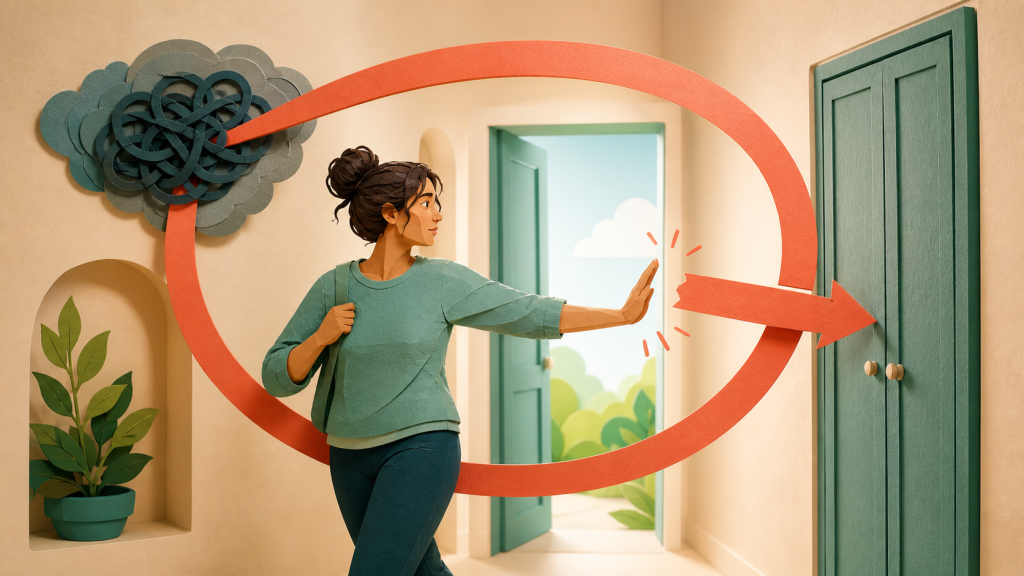
To interrupt stress eating, relying on a stronger “no” at the decisive moment is rarely enough. The hand moving toward biscuits, crisps or chocolate is often the final part of a loop that started earlier: a tense meeting, too little sleep, a packed train, arriving home overstimulated or finally being alone after a demanding day.
Food may briefly provide distraction, comfort or a transition into rest. That does not make you weak. It means your brain has learned a fast, available response. The practical question is not, “How do I become more disciplined?” A better question is, “Where can I add a small interruption before the automatic choice is complete?”
This article provides general information and cannot diagnose a condition. If you regularly binge, feel out of control, eat secretly or experience substantial shame and distress around food, talk to your GP or another qualified health professional. Those symptoms deserve support, not stricter lifestyle rules.
Understand the stress-eating loop
A useful model has four links:
1. **Trigger:** something happens outside or inside you, such as time pressure, conflict, fatigue, boredom or loneliness.
2. **Tension:** you notice agitation, emptiness or a need for comfort or reward.
3. **Automatic action:** you walk to the cupboard, open a delivery app or pick up food without a deliberate decision.
4. **Short reward:** taste and distraction soften the tension briefly; the original stress may then return, sometimes with guilt added.
The Mayo Clinic describes how emotions and everyday stressors can become automatically linked with eating. Guilt may then feed the same cycle. Learning to interrupt stress eating is therefore about noticing the process earlier, not punishing yourself afterwards.
One snack does not prove that you have a problem. People also eat for taste, celebration and pleasure. The pattern matters when food repeatedly becomes your default response to tension, causes distress or starts controlling your choices.
Find the moment before the snack
Do not begin with a perfect food diary. For three to seven days, record only the situations in which the urge to snack felt strong. Four short questions are enough:
- Where was I, and what time was it?
- What happened in the previous ten minutes?
- Did my body feel hungry, tired, tense or restless?
- What did I hope food would do for me then?
Look for repetition. Your loop may not start with stress in general, but specifically after a video call, during the transition from work to evening, after an inadequate lunch or whenever snacks are visible beside you. A precise trigger gives you somewhere to act.
It can help to distinguish physical hunger from emotional urgency, without pretending that this is always obvious. Physical hunger often grows gradually, and several meals sound acceptable. An emotional urge may arrive suddenly and focus on one food. Yet stress and genuine hunger can coexist. If you have not eaten for hours, a balanced meal or planned snack may be more useful than distraction.
Interrupt stress eating with a small pause
The pause does not have to be a heroic twenty-minute meditation. Start with sixty to ninety seconds. Put both feet down, exhale slowly and name what you notice: “I feel tense, and I want something crunchy.” That is observation, not prohibition. This tiny action can interrupt stress eating before your surroundings make the choice for you.
Then ask three questions:
1. Am I physically hungry?
2. What need exists alongside food: rest, release, comfort, connection or a clear ending to the day?
3. Which two-minute action best fits that need?
An NHS guide to tackling emotional eating recommends creating a delay between an impulse and available comfort food. The urge does not have to disappear completely during that delay. The aim is to create a choice again. You interrupt stress eating by making room for that choice, not by demanding that every craving vanish.
To interrupt stress eating does not mean that food is forbidden. After the pause, you may still deliberately decide to eat. Portion it, sit down and taste it. A chosen snack is different from suddenly noticing the bottom of a bag.
Match the alternative to the trigger
A random “healthy alternative” will not always work because a carrot is not an answer to every feeling. Match the action to what you actually need:
- **Rushed after work:** walk outside for two minutes, or wash your face and change clothes as a transition ritual.
- **Angry or overstimulated:** set a two-minute timer and write down what is bothering you without editing; keep or delete it afterwards.
- **Lonely:** send one specific message or arrange a short call.
- **Tired:** soften the lights, close one screen and decide whether sleep or a real meal is needed.
- **Bored:** choose an activity involving your hands, music or a short task with a visible ending.
- **Truly hungry:** eat a planned meal or satisfying snack instead of treating hunger as a character test.
Your alternative does not have to solve the source of stress. It only needs to fit the need better and buy enough time to prevent an automatic response. Sometimes a combination is appropriate: release tension for two minutes, then consciously have a snack. To interrupt stress eating consistently, keep the alternative brief, specific and available at the time your trigger usually appears.
Make your environment support the pause
Your surroundings determine how many steps exist between urge and food. Keep trigger foods out of immediate sight, buy a smaller pack or store them somewhere less direct. Make foods you intentionally choose as snacks easier to reach. The goal is not a sterile kitchen; it is a few extra seconds of decision space.
Place a neutral reminder on the cupboard, such as a coloured dot with no moralising message. The dot means: feet down, name the need, then choose. Also prepare the alternative: shoes near the door, headphones on a hook or the number of someone you can call.
You can also reset your kitchen environment so the room creates fewer automatic cues. That approach can help interrupt stress eating, provided you use it as calm support rather than another test of perfection.
The Dutch Nutrition Centre, Voedingscentrum, recommends if-then plans for difficult eating situations. Make yours specific: “If I walk to the snack cupboard after my last meeting, I will first make tea and stand on the balcony for two minutes. Then I will decide again.”
A useful if-then plan contains no punishment. “If I snack, I will skip breakfast tomorrow” is likely to add hunger and guilt. Choose a plan that intervenes before the action and remains possible on a busy day.
Repeat the wording until it becomes easy to recall: “When this trigger appears, I pause before I choose.” A rehearsed sentence can interrupt stress eating more reliably than inventing a solution while already overwhelmed.
Do not let under-eating strengthen the loop
Not every evening snack is emotional. If you postpone meals all day or deliberately eat very little, you may arrive home with biological hunger and less mental energy. That makes efforts to interrupt stress eating needlessly hard.
Aim for a reasonable meal rhythm that fits your day. Meals can include vegetables or fruit, a protein source, whole grains and other fibre-rich choices. You do not need to build a “perfect” menu. Regularity alone may help prevent genuine hunger from piling onto stress.
This distinction matters: you cannot reliably interrupt stress eating by ignoring physical hunger. Feed genuine hunger appropriately, then use the pause for the part of the urge that is asking for comfort, escape or transition.
Be careful with absolute bans, too. The thought that you may never have chocolate again can make one decision feel larger and more charged. Instead, leave room for pleasure and eat it attentively. Mayo Clinic likewise cautions that excessive restriction may intensify cravings, particularly around emotions.
Remove shame from the review
After an automatic eating episode, you may want to compensate, insult yourself or label the day a failure. That rarely provides useful information. Use a short factual review instead:
- The trigger was an argument just before I came home.
- I had eaten nothing since lunch.
- The open bag of crisps was visible.
- Next time I will eat my planned afternoon snack and walk around the block first when I arrive.
That is learning without giving up responsibility, and accountability without humiliation. The ability to interrupt stress eating is a skill; skills improve through repetition and adjustment. One missed pause does not erase earlier choices.
You may interrupt stress eating on Monday and miss the cue on Tuesday. Review the difference with curiosity: timing, hunger, visibility and emotional intensity are all useful data. Each factual review makes the next attempt to interrupt stress eating more specific.
When extra support is appropriate
Seek professional help if you often eat a large amount in a short time, experience loss of control, eat until uncomfortably full, eat alone or secretly because of embarrassment, compensate afterwards or feel substantial psychological distress. The US National Institute of Mental Health lists such experiences among signs of binge-eating disorder and other eating disorders. Only a professional can assess what is happening.
Your GP can discuss next steps and, when appropriate, refer you to a psychologist or dietitian experienced in eating behaviour. You do not have to wait until your symptoms feel “serious enough”. Early support may prevent the loop from becoming stronger.
Professional support is not evidence that you failed to interrupt stress eating alone. It is an appropriate way to understand a persistent pattern and build safer, more personal strategies.
Try one experiment this week
Choose one recurring moment, not your entire eating pattern. Write one if-then plan and test it for seven days:
Use a short check. **Stress eating** often begins before you reach the kitchen, so record the first tension. **Stress eating** can coexist with physical hunger, so check when you last ate. **Stress eating** becomes more automatic when the desired food is immediately visible, so change one cue. **Stress eating** does not always call for distraction; sometimes a meal is the fitting response. **Stress eating** caused by fatigue may call for rest, while **stress eating** after conflict may call for release or contact.
Keep the interpretation neutral. **Stress eating** is information about a situation and a learned response. **Stress eating** on one difficult day does not predict tomorrow. **Stress eating** need not disappear completely before you can see progress: one conscious pause already changes the sequence. By observing **stress eating** in comparable situations, you turn a vague struggle into a specific skill you can practise.
> If I automatically walk toward the cupboard after a stressful workday, I will put both feet down, name what I need and do my chosen two-minute alternative. Then I will consciously decide whether to eat.
Record only whether you made the pause and what you learned—not your “score”, your guilt or how perfect the day was. If sixty seconds created some space, you changed the loop. If it did not work, make the trigger more specific or the alternative smaller.
Keep the experiment narrow. Trying to interrupt stress eating at one predictable time produces clearer information than monitoring every bite all day. Once that pause becomes familiar, choose a second trigger and practise how to interrupt stress eating there.
Learning to interrupt stress eating does not begin with never snacking again. It begins with one moment in which an automatic reaction becomes a choice.


