
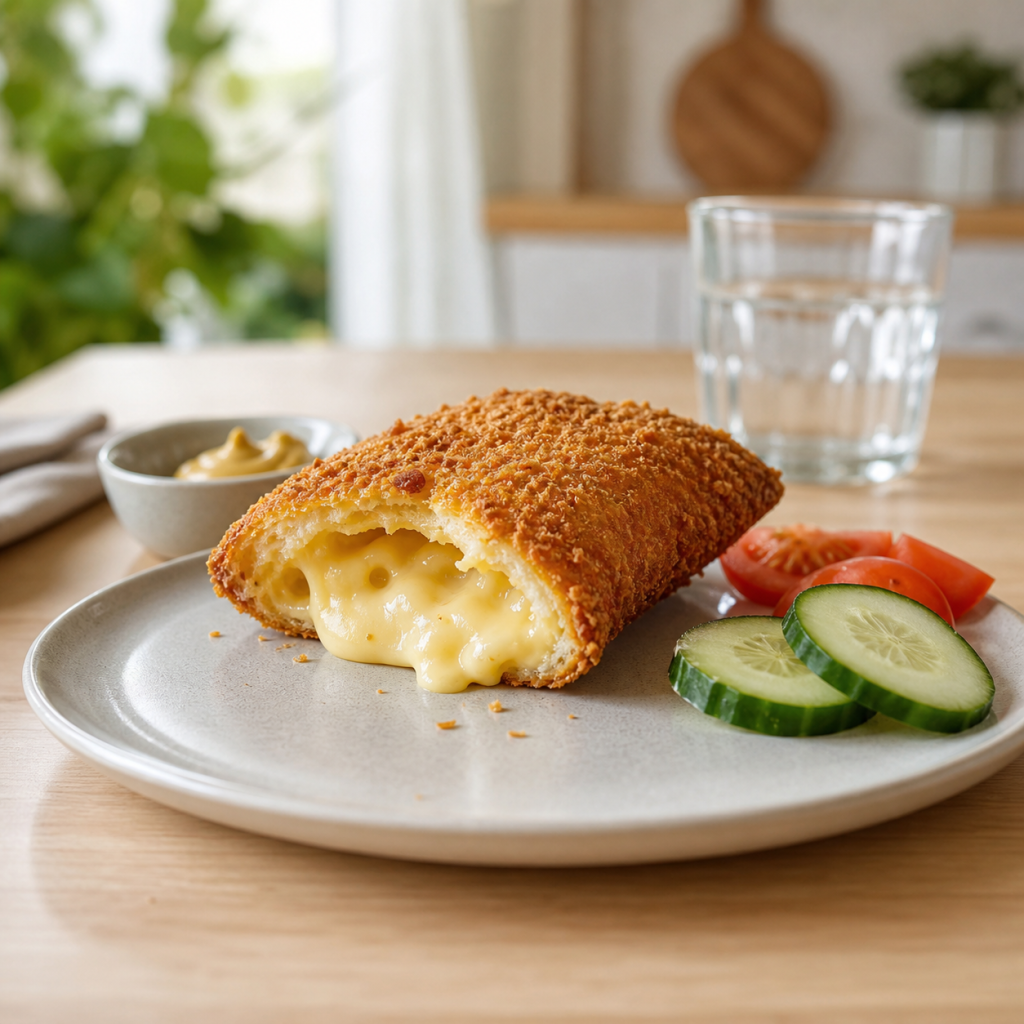
Kaassouffle calories look harmless at first. It is a small Dutch snackbar snack, it contains no meat, and it is often thinner than a croquette. That is exactly why people underestimate it. A kaassouffle is small in volume, but energy dense because of pastry, cheese filling and fat from preparation.
At FitterVitaal, we look at kaassouffle calories without food panic. You do not need to ban a kaassouffle if you want to lose weight. You just need to understand why this small snack can add up faster than it looks. That makes the choice calmer and more honest.
The short version: according to the Dutch Nutrition Centre, 1 kaassouffle of 50 grams contains about 152 kcal. An uncooked kaassouffle of 60 grams contains about 182 kcal. A prepared kaassouffle of 57 grams contains about 205 kcal, with 13.2 grams of fat and 5 grams of saturated fat. Kaassouffle calories therefore come from the full combination of pastry, filling and preparation, not only from cheese.
Kaassouffle calories: quick comparison
Kaassouffle calories depend on product, size and preparation. A snackbar version can differ from an oven version from the supermarket. Still, the Dutch Nutrition Centre values give a useful anchor for everyday choices.
| Product | Portion | Kcal | Fat | Saturated fat | Carbs | Protein | Salt |
| --- | ---: | ---: | ---: | ---: | ---: | ---: | ---: |
| Kaassouffle | 50 g | 152 kcal | 7.7 g | 3.8 g | 16.4 g | 4 g | 0.84 g |
| Kaassouffle, uncooked | 60 g | 182 kcal | 9.2 g | 4.5 g | 19.7 g | 4.9 g | 1.01 g |
| Kaassouffle, prepared | 57 g | 205 kcal | 13.2 g | 5 g | 17 g | 4.2 g | 0.87 g |
This table shows why kaassouffle calories are often underestimated. The snack feels light in your hand, but each piece contains a relatively high amount of fat and very little fibre. A prepared kaassouffle also does not provide much protein for the amount of energy. It can taste great, but it may not keep you full for long.
Why a small snack can be energy dense
Energy dense means that a product provides a lot of energy in a small amount of food. Kaassouffle calories fit that pattern. The outside is pastry or a pastry-like coating. The inside is a cheese filling. Then comes the cooking method, often frying or another fat-rich way to make it crisp.
That is what makes the snack appealing: crisp outside, soft and salty inside. The same features make kaassouffle calories compact. Fat provides more kcal per gram than carbohydrates or protein. A snack with pastry, cheese and cooking fat does not need to be large to contribute meaningful energy.
The practical lesson is simple. Do not judge a snack only by size. An apple, bowl of yoghurt or wholegrain sandwich may look larger, but can be less energy dense and more filling. A kaassouffle is smaller, but the composition is richer.
For tracking, consistent language helps. Treat kaassouffle calories as snack energy in a small package. When you plan kaassouffle calories beforehand, kaassouffle calories are easier to manage than when you try to guess afterward. That makes kaassouffle calories a normal planning number.
Pastry, cheese filling and fat
Kaassouffle calories come from three parts. The first layer is the pastry. It gives structure and carbohydrates, but little fibre. That means it usually fills you less than wholegrain bread, potatoes, legumes or vegetables. The snack feels airy, but the pastry still counts.
The second layer is the cheese filling. Cheese gives flavour, salt, fat and some protein. For some people, the word cheese sounds more nutritious than meat ragout, but that does not make the snack automatically light. Cheese contains fat, and in a kaassouffle it sits inside a snack filling, not inside a balanced meal with vegetables and wholegrain foods.
The third layer is preparation. Frying or crisp preparation mainly increases the fat impact. That is why prepared kaassouffle calories can be higher than people expect. The crisp edge is the appeal, but it is also the reason this is not a neutral snack.
Vegetarian does not automatically mean light
A common misunderstanding is that vegetarian means low in kcal. Kaassouffle calories show why that is not true. A kaassouffle contains no meat, but it does contain pastry, cheese, fat and salt. Vegetarian describes ingredients, not automatically energy density.
That does not make vegetarian snacks bad. It means you can judge them as honestly as any other snack. A vegetarian choice can be sustainable, practical or tasty while still being calorie dense. For weight loss, the total energy intake, fullness and repeat behaviour matter more than the label.
If you want vegetarian snacks or meals with more satiety, look for more protein, fibre or volume. Think of meals with legumes, wholegrains, vegetables, eggs, tofu, tempeh or lower-fat dairy. A kaassouffle can still fit beside that, but it is a snack, not proof that the choice is automatically light.
One kaassouffle, two kaassouffles or snack stacking
The biggest difference is often not the first snack, but what happens after it. One prepared kaassouffle of about 205 kcal can easily fit in a day. Two pieces are already around 410 kcal. Three pieces are around 615 kcal. At that point, kaassouffle calories are no longer a tiny extra.
Snack stacking makes this harder. A kaassouffle next to fries, sauce, soft drink and later party snacks may feel small in separate parts. Together it becomes a large meal. Many people do not gain weight from one kaassouffle, but from several small extras that are never treated as real energy.
That is why choosing beforehand helps. If you take a kaassouffle as a snack, keep it a snack. If it is part of a snackbar meal, count the whole meal. Kaassouffle calories become useful only when the context is included.
Sauces and drinks count too
Mustard or a small dip may not change much, but larger sauce portions change the total. Mayonnaise, peanut sauce, garlic sauce and other high-fat sauces can make the snack much heavier. The kaassouffle itself already contains fat, so extra fatty sauce stacks quickly.
Drinks are the same trap. Soft drink, milkshake or alcohol next to a snack increases the total without necessarily keeping you full for longer. Water, unsweetened coffee or a zero drink can be practical when the kaassouffle is the snack you actually want.
This is not about strict rules. It is about choosing what is worth it. If you mainly want the crisp cheese snack, let the kaassouffle be the main event. Do not automatically add sauce and calorie-rich drinks just because they are available.
Can kaassouffle calories fit weight loss?
Yes, kaassouffle calories can fit weight loss. A snack of 152 to 205 kcal is not automatically a problem. It becomes a problem when you do not count it, take several pieces or add it on top of an already complete meal.
If you use a daily budget, plan the snack consciously. If your lunch is normally 500 kcal and you add a kaassouffle, your day changes. If you replace another snack moment with a kaassouffle, it may fit your week perfectly well. The difference is replacing versus stacking.
If you want to know how much room you have, use the FitterVitaal calorie need tool. For wider context, you can also read our calculator tools for BMI, body fat and calories. Kaassouffle calories become less emotional when you know your total pattern.
How to track kaassouffle in Vytal
In the Vytal app through FitterVitaal you can keep kaassouffle calories simple. If you have a prepared snackbar piece without a label, use about 205 kcal as an anchor. If you have a smaller general kaassouffle, 152 kcal may be closer. For supermarket products, the package label comes first.
Track what you actually ate. An oven version, air fryer version or snackbar version can differ. A large kaassouffle is not the same as a small piece. Two pieces are not "one small snack"; they are two snacks.
Perfect weighing is not required. Consistent realistic logging matters more than being exact once. If your weekly average is honest, kaassouffle calories become information instead of guilt.
Smarter choices without banning snacks
You can fit kaassouffle calories more easily with small choices. Take one piece instead of two. Pair it with water instead of a calorie-rich drink. If it is a lunch moment, add something with volume, such as raw vegetables, salad or non-creamy soup. Save fries and fatty sauce for moments when you truly want them.
At home, you have more control. Oven or air fryer preparation can still differ per brand, but at least you can read the package. You can plan portions and build a simple meal around the snack. That is calmer than guessing afterward what was in a snackbar bag.
The best choice is not always the lowest choice. Sometimes you simply want the classic snack. Then you take it, count it and move on. That is more sustainable than banning everything and overeating later.
Common mistakes with kaassouffle calories
The first mistake is thinking that small automatically means low. Kaassouffle calories are compact because of pastry, cheese and fat. The second mistake is thinking that vegetarian automatically means lean. Vegetarian can still be energy dense.
The third mistake is counting the snack without sauce, drinks or a second portion. The fourth mistake is panicking over the scale the next morning. Salt and carbohydrates can make you hold some temporary water. That is not instant body fat.
The fifth mistake is compensating with guilt. A kaassouffle does not require a crash day. Return to your normal meals, eat enough protein, fibre and vegetables, and look at your weekly average. Kaassouffle calories are a data point, not a judgement.
FAQ about kaassouffle calories
How many calories are in a kaassouffle?
According to the Dutch Nutrition Centre, 1 kaassouffle of 50 grams contains about 152 kcal. A prepared kaassouffle of 57 grams contains about 205 kcal.
Why does a kaassouffle contain so many kcal for a small snack?
Kaassouffle calories come from pastry, cheese filling and fat from preparation. That makes it energy dense: small in volume, but relatively rich in energy.
Is a kaassouffle healthier because it is vegetarian?
Not automatically. Vegetarian means no meat, but not automatically low in calories, fat or salt. Look at the whole product and your full day.
Can a kaassouffle fit in a calorie deficit?
Yes, if you count it and your daily or weekly average still fits. Watch double portions, sauce, drinks and snack stacking.
What is better: oven, air fryer or deep fryer?
That depends on the product and how much fat is added during preparation. Check the package when preparing at home and use a realistic anchor for a snackbar piece.
Conclusion
Kaassouffle calories are not complicated, but they are easy to underestimate. Use about 152 kcal for a standard 50 gram piece and about 205 kcal for a prepared 57 gram kaassouffle. The snack is small, but energy dense because of pastry, cheese filling and fat.
You do not need to ban the kaassouffle. Choose consciously, count it as a real snack, avoid automatic snack stacking and remember that vegetarian does not automatically mean light. Then it remains a normal Dutch snack inside a broader eating pattern.


