
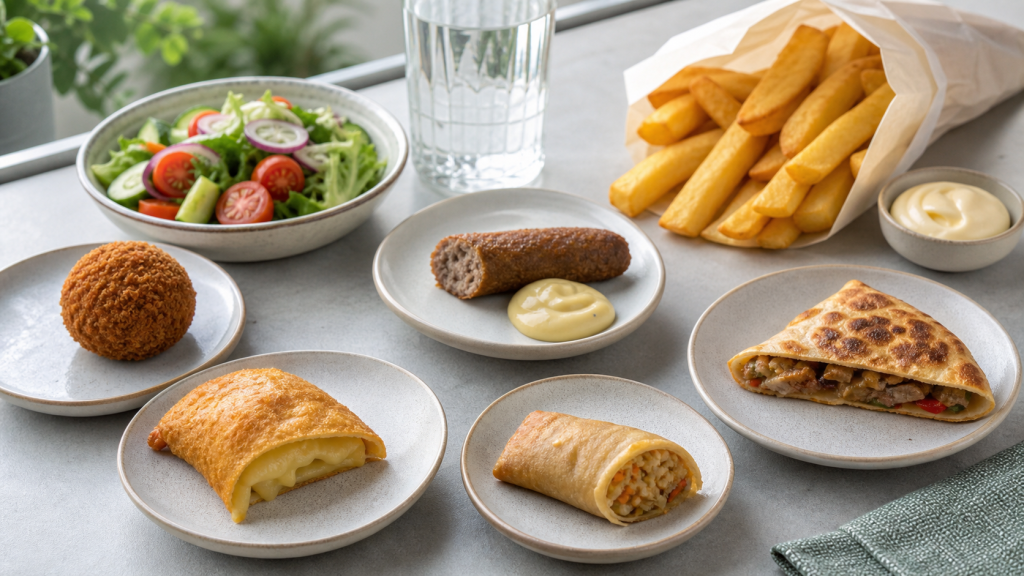
Dutch snack calories are useful when you want to lose weight, but they are not a guilt score. A Dutch snackbar visit is simply an eating moment with many possible sizes. A kapsalon is usually a full meal, a frikandel can be a snack, patat oorlog sits somewhere in between, and a broodje kroket often behaves like lunch. When you understand Dutch snack calories, you can choose better without moralising food.
At FitterVitaal we use Dutch snack calories as practical information. The goal is not to avoid the snackbar forever. The goal is to know when a snack is actually a meal, when sauce is the biggest extra and when the rest of your day needs a little more structure. That keeps tracking human.
The short version: the Dutch Nutrition Centre lists 950 kcal for 1 kapsalon of 440 grams. A frikandel of 85 grams contains 200 kcal, while a frikandel speciaal of 140 grams contains 322 kcal. Fries with peanut sauce of 200 grams contain 522 kcal, and fries with sauce and onions of 175 grams contain 446 kcal. Those values show why Dutch snack calories are mostly shaped by portion size, sauce, fat and stacking.
Dutch snack calories: start with the eating moment
Dutch snack calories are easiest to compare when you first define the eating moment. Is it a snack, lunch, dinner or a social bite with drinks? One frikandel next to a normal day is very different from a kapsalon with sauce, soda and another snack. The food group may look similar, but its role in your day is different.
Avoid moral categories such as good and bad. Use practical categories instead. Small means it can fit beside normal meals. Medium means the rest of your day matters. Large means you should treat it as a meal. Dutch snack calories become clearer when you decide that role before you start logging.
The Dutch Nutrition Centre gives useful context through its Schijf van Vijf guidance. Snacks, soda and comparable products usually sit outside the core daily food pattern. That does not mean never, but it does mean there is limited room. The guidance mentions several small choices beside the Schijf van Vijf each day and a few larger choices per week. Dutch snack calories fit better when those larger choices are planned.
A quick comparison of Dutch snack calories
Dutch snack calories vary mostly through size and toppings. This table is not a complete menu, but it gives reliable anchors and a FitterVitaal article for each snack.
| Choice | Practical anchor | What changes it? | Read more |
| --- | ---: | --- | --- |
| Kapsalon | 950 kcal per 440 g | fries, meat, cheese, sauce and size | kapsalon article |
| Frikandel | 200 kcal per 85 g | speciaal, pastry, sauce and a second snack | frikandel article |
| Patat oorlog | fries with peanut sauce 522 kcal per 200 g | peanut sauce, mayo, onions and fries size | patat oorlog article |
| Broodje kroket | lunch context matters | bread, ragout, frying and a second kroket | broodje kroket article |
| Kaassouffle | small snack, dense filling | pastry, cheese filling and sauce | kaassouffle article |
| Bitterballen | party portions add up | number of pieces, mustard, drinks and sharing | bitterballen article |
| Loempia | snack roll or meal loempia | size, filling, frying and sauce | loempia article |
| Turkish pizza | base plus additions | garlic sauce, cheese, doner and salad | Turkish pizza article |
Use the table as a decision map. Dutch snack calories are not exact for every shop, but you do not have to guess blindly. Pick the best anchor, add visible extras and round realistically instead of choosing the lowest database entry every time.
Why sauce is often the hidden extra
Many people count the snack and forget the sauce. That is where Dutch snack calories often rise. The frikandel example is clear: a regular frikandel of 85 grams contains 200 kcal according to the Dutch Nutrition Centre, but a frikandel speciaal of 140 grams contains 322 kcal. The difference is mostly sauce, curry or ketchup and onions.
Fries show the same pattern. Fries with peanut sauce of 200 grams contain 522 kcal. Fries with sauce and onions of 175 grams contain 446 kcal. This does not make sauce forbidden. It simply means sauce is part of the meal, not decoration without energy.
Ask for sauce on the side when you want more control. Use the amount you truly enjoy and leave the rest. It sounds small, but for Dutch snack calories this is often the easiest win. You keep the flavour while making the portion visible.
Kapsalon and frikandel in short
The kapsalon is the large meal in this snack family. Our article on how many calories are in a kapsalon explains how fries, meat, cheese, garlic sauce and salad can build a container of around 950 kcal. The main lesson: a kapsalon can fit, but treat it as a meal instead of a small extra. Dutch snack calories around kapsalon are mostly a story of size.
The frikandel is smaller, but easier to stack. Our article on frikandel calories covers regular frikandel, frikandel speciaal, frikandelbroodje and vegetarian versions. The lesson there: a single frikandel is manageable, but speciaal sauce, pastry, fries and soda change the whole eating moment. Dutch snack calories around frikandel are mostly a story of extras.
This hub does not rewrite those two guides. Use them when you want to count that specific snack. Use this page when you want to compare Dutch snack calories across several snackbar choices.
Patat oorlog, broodje kroket and kaassouffle
Patat oorlog shows how fries become a meal through sauce. Peanut sauce, mayo and onions taste good, but they also add energy. If patat oorlog is your main choice, you do not automatically need two extra snacks beside it. Dutch snack calories stay easier to manage that way.
A broodje kroket often feels like lunch. That is the right context for it. Bread, ragout and frying fat count together. If you add soup, soda or a second kroket, the lunch changes quickly. Read the separate article on broodje kroket calories if this is a regular choice for you.
The kaassouffle is small, but pastry and cheese filling make it dense. Vegetarian does not automatically mean light. The article on kaassouffle calories is useful if you assume small always means low. Dutch snack calories are not only about size; they are also about rich fillings.
Bitterballen, loempia and Turkish pizza
Bitterballen rarely stay at one piece. That is why bitterballen calories are mostly about numbers, party context and drinks. Four bitterballen with mustard are different from eight pieces with beer and a full dinner later. Dutch snack calories often become invisible at social tables because everyone shares.
A loempia can be a small snack roll or a large meal loempia. That difference matters more than the name. The article on loempia calories explains how size, filling and sauce determine whether it behaves like a snack or a meal.
Turkish pizza starts with a thin base, but garlic sauce, cheese and doner make the total larger. The article on Turkish pizza calories shows how to count the base, sauce and additions separately. Dutch snack calories are more honest when a Turkish pizza with doner is treated as a meal.
How to track Dutch snack calories without obsessing
Start with the best match in your app. Choose kapsalon, frikandel, patat oorlog, broodje kroket, kaassouffle, bitterballen, loempia or Turkish pizza. Then decide whether the portion was small, normal or large. Add sauce, cheese, doner, bread, soda or alcohol separately when they were clearly present.
Do not always pick the lowest entry. It may feel good in the moment, but it makes your weekly data useless. Dutch snack calories do not have to be perfectly exact. They need to be consistently honest. If you order from the same snackbar every Friday, save your usual meal as a favourite in the Vytal app through FitterVitaal and adjust it to your real order.
Also remember salt. Snackbar meals are often salty. Your weight may be temporarily higher the next morning because of water retention. That is not immediate fat gain. Look at weekly averages instead of reacting to one salty meal.
Smarter ordering without banning snacks
The best choice is not always the lightest choice. The best choice is the one that matches your hunger, goal and the rest of your day. If you truly want kapsalon, choose kapsalon and plan it as dinner. If you want something small, choose one snack and skip fries or soda. If you want sauce, ask for it on the side.
Use food swaps practically. The Dutch Nutrition Centre describes Eetwissels as small steps inside what you already eat. For Dutch snack calories, that can mean water or zero soda instead of sugary soda, small fries instead of large, sauce on the side instead of poured over, extra salad instead of extra cheese, or one deliberate snack instead of automatically taking two.
Do not make it too strict. Strict eating often creates all-or-nothing behaviour. A planned snack usually works better than a forbidden snack that turns into overeating later. Dutch snack calories help you stay calm: see the number, make a choice and move on.
Example: snackbar food in a normal weight-loss day
Suppose you aim for about 2100 kcal per day. A regular frikandel or broodje kroket can fit fairly easily. A kapsalon or patat oorlog needs more room. You do not create that room by starving yourself, but by keeping breakfast and lunch rich in protein and fibre.
A practical day could include yogurt with fruit, a wholegrain lunch with protein and vegetables, fruit as a snack and then a snackbar meal for dinner. Drink water, choose sauce consciously and stop when you have had enough. Dutch snack calories then become part of a pattern instead of a chaotic moment.
If you want to calculate your own room, use the FitterVitaal calorie needs tool. After that, Dutch snack calories are easier to place: not as a forbidden category, but as a choice inside your week.
Common mistakes with Dutch snack calories
The first mistake is counting a meal as a snack. A kapsalon, Turkish pizza with doner or large loempia is usually a meal. The second mistake is forgetting sauce. The third mistake is forgetting drinks. Soda, beer or a milkshake can make the eating moment much bigger.
The fourth mistake is not counting shared portions. Bitterballen from the table still count even when nobody puts them on your plate. The fifth mistake is panicking about scale weight after a salty meal. Dutch snack calories are about energy intake; the scale also reacts to salt, carbohydrates and water.
The sixth mistake is thinking tracking must be perfect. It does not. Choose a reasonable estimate, learn from your weekly average and adjust. Dutch snack calories are a tool, not a judgment.
FAQ about Dutch snack calories
Which Dutch snackbar snack has the fewest calories?
It depends on portion and preparation. A single snack is usually lower than a full meal such as kapsalon or Turkish pizza with doner. But sauce, bread, fries and drinks can make a small choice much bigger.
Can I eat snackbar food while losing weight?
Yes. Weight loss depends on your total energy balance over time. Dutch snack calories can fit when you count the portion honestly and give the eating moment a clear place in your day or week.
Do I always need to avoid sauce?
No. You do not need to avoid sauce. Ask for it on the side, choose the amount you truly enjoy and count it. That is usually more sustainable than a strict ban.
Why do I weigh more after snackbar food?
Often because of salt, carbohydrates and water. That is temporary and not the same as immediate fat gain. Look at your weekly average.
Sources
- Dutch Nutrition Centre: calories in kapsalon
- Dutch Nutrition Centre: calories in frikandel
- Dutch Nutrition Centre: calories in frikandel speciaal
- Dutch Nutrition Centre: fries with peanut sauce
- Dutch Nutrition Centre: fries with sauce and onions
- Dutch Nutrition Centre: healthy eating with the Schijf van Vijf
- Dutch Nutrition Centre: Eetwissels


